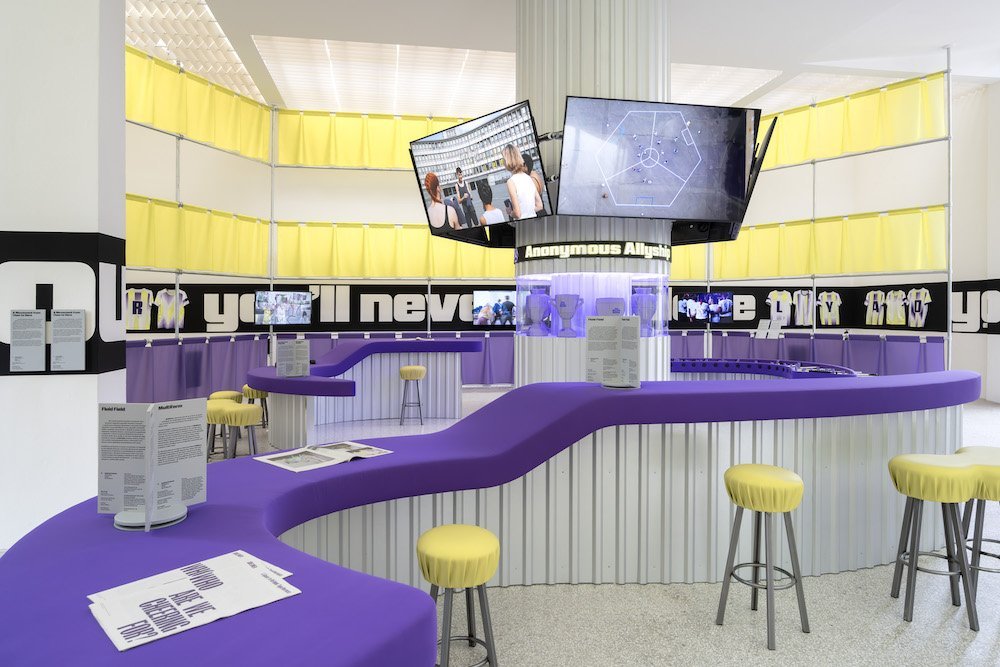
Sidelined, Dutch Pavilion at the 2025 Venice Architecture Biennale 2025 – Photos by Cristiano Corte unless stated otherwise.
Architecture. Sports bars are social, convivial and playful spaces that promote a sense of belonging and bridge social gaps by uniting diverse people across social, economic, and cultural divides. However, given their competitive nature and masculine imprinting, some people may be excluded. From here, the Dutch Pavilion at the 2025 Venice Architecture Biennale presents SIDELINED: A Space to Rethink Togetherness, an exhibition questioning the rules and rituals of social interaction with an inclusive approach.
- RELATED STORIES: Read more about the 2025 Venice Architecture Biennale on Archipanic.

The pavilion at Giardini is transformed into an unconventional yellow, white, purple and black sports bar, featuring trophies, scarves, a fluid table soccer game, and screens showcasing new games with non-binary competitions. Social designer Gabriel Fontana reimagines how we play, gather, and compete, changing the rules of the game. “We invite visitors to engage, have fun – but also to reflect on how we can create more inclusive communities,” Social designer Gabriel Fontana told Archipanic.
[su_image_carousel source=”media: 43840,43841″ limit=”0″ slides_style=”minimal” crop=”none” columns=”2″ spacing=”no” dots=”no” autoplay=”1″ speed=”immediate”]
Curated for Het Nieuwe Instituut by Amanda Pinatih, SIDELINED adopts sports as a lens to examine how spatial design can reveal and disrupt the exclusionary dynamics that exist in everyday environments. The exhibition emerged from comprehensive research conducted in Dutch sports bars across the Netherlands. Pinatih shared with Archipanic, “Gabriel and I talked to football supporters and bar owners. Sport is the perfect tool to bring people together.”

Gabriel Fontana also presents three alternative sports: Multiform, Anonymous Allyship, and Fluid Field. With transformable uniforms, shifting playing fields, and unknown teams, these imagined sports allow players to explore innovative connections devoid of preset roles and structures. Through seemingly simple alteration of the rules, these games reinvent sports as a form of queer pedagogy that questions the boundaries of competition, collaboration, and orientation.
- RELATED STORIES: Discover more sport-related architecture and design on Archipanic.
[su_image_carousel source=”media: 43846,43847″ limit=”0″ slides_style=”minimal” crop=”none” spacing=”no” captions=”yes” dots=”no” autoplay=”1″ speed=”immediate”]
Screens showcase matches of the new games at the Pier Luigi Penzo stadium in Venice. The yellow, white, purple, and black uniforms and scarves echo the Non-Binary flag created by Kye Rowan in 2014 [Read more about the history and design of LGBT flags]. Soft, huggable trophies are positioned at the centre of the exhibition. The curvy table soccer invites visitors to play together on just one side; there are no opposing teams and no rules, only fun!

SIDELINED queers the sports bar as a sociopolitical field to explore themes of belonging, laying the ground for new modes of togetherness. “By looking at how sports bars facilitate interactions among diverse groups while fostering divisions, the exhibition offers insights into creating inclusive public spaces,” Says Gabriel Fontana.
- RELATED STORIES: Discover more queer architecture and design on Archipanic.
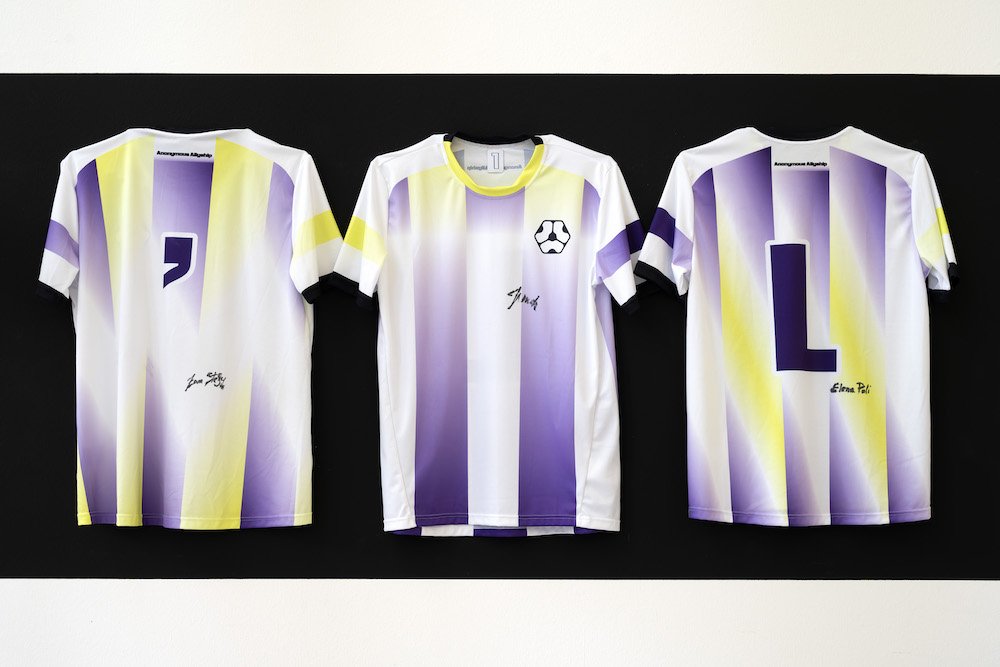
The pavilion-turned-sports bar, created by Koos Breen and Jeannette Slütter, is a venue for fluidity, experimentation, and empowerment where binary oppositions, social hierarchies, and cultural values can be challenged and transformed. In this environment, competition is largely absent; instead, sports serve as a unifying force between communities.

All photos are by Cristiano Corte unless stated otherwise, courtesy of the Netherlands Pavilion in Venice.
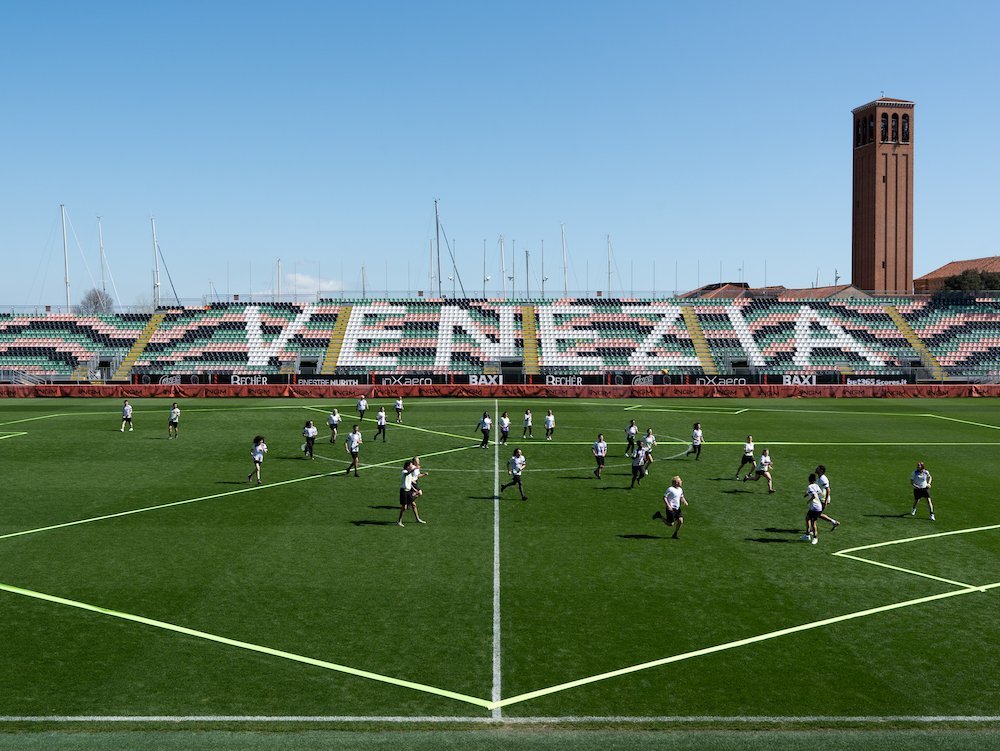
Gabriel Fontana’s Anonymous Allyship at the Pier Luigi Penzo stadium in Venice – Photo by Giacomo Bianco.
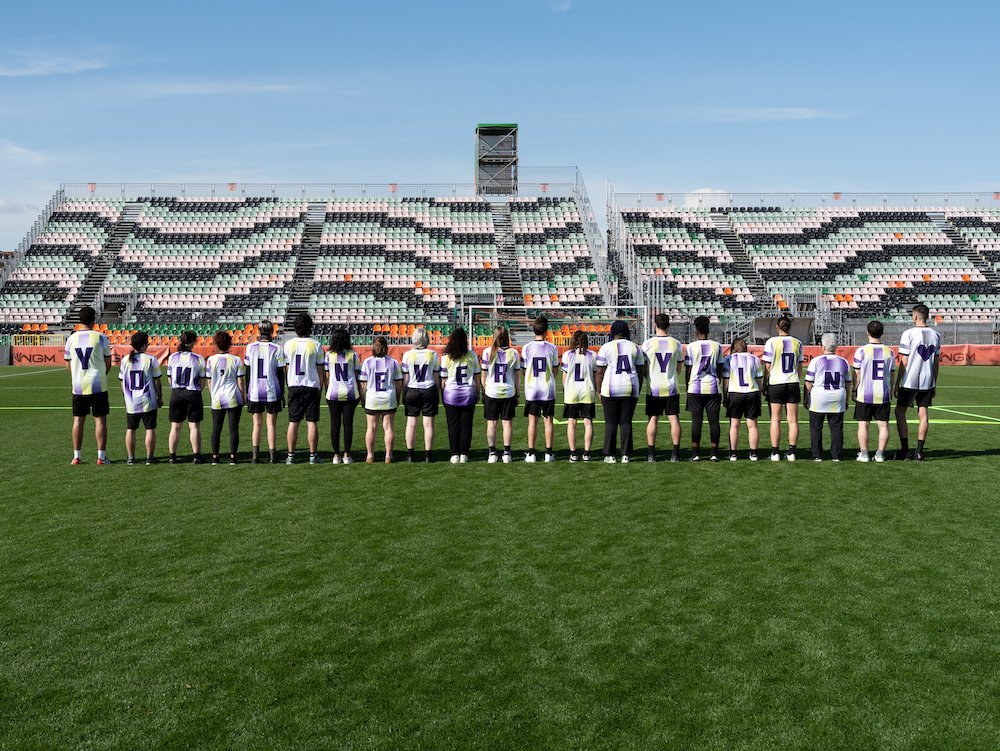
Gabriel Fontana’s Anonymous Allyship at the Pier Luigi Penzo stadium in Venice – Photo by Giovanni Pellegrini.