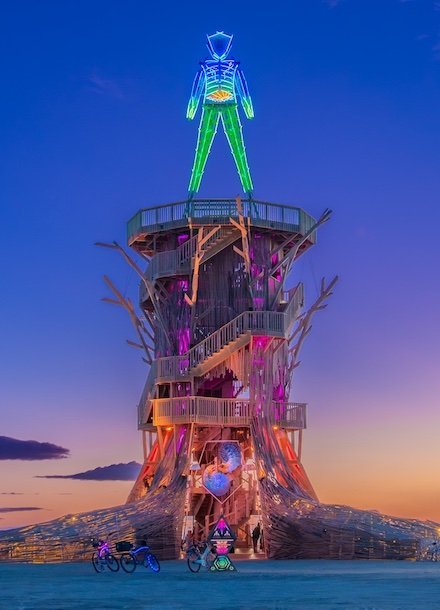
The Man Pavilion at Burning Man 2025 – Photo via IG, follow Mark Fromson @autobiographica @kidnetick @markriverapr
Art & Architecture. Once again, Archipanic braved the vastness of Nevada’s Black Rock Desert, where Burning Man 2025 unfolded under tough conditions. Sandstorms, mud, even tragic loss — and yet, in true Burning Man spirit, a new life also arrived. Against all odds, over 70,000 people came together to build Black Rock City, a fleeting metropolis glowing with radical creativity, resilience, and connection. This year’s theme, Tomorrow Today, invited dreamers to imagine futures through collective creativity, echoing the optimism of world fairs past. Our journey through this year’s edition revealed breathtaking art, otherworldly shrines, and ingenious architecture.
- RELATED STORY: Read more about Burning Man on Archipanic.

Photo via IG, follow @temple_of_the_deep
At its spiritual heart stood the Temple of the Deep by Spanish architect Miguel Arraiz. Rising like a fractured black rock, the shrine symbolised vulnerability, loss, and renewal. Rooted in the timeless archetypes of caves and mountains, the temple’s raw tectonic form concealed subtle Baroque influences that guided light, movement, and sightlines. Inside, visitors experienced an atmosphere where solitude and community intersected, creating a shared space for reflection, healing, and transformation. Read more…

Photo by Scott London.
The World Fair of Unity, this year’s Man Pavilion by Mark Kidnetick Rivera, towered as a Gothic revival-meets-digital-future spectacle. Inspired by the grand architecture of 19th-century world fairs, it celebrated global creativity and diversity. Its soaring arches and cutting-edge interactive installations invited citizens of Black Rock City to gather, collaborate, and dream about a shared humanity.

The Man Pavilion – Photo via IG, follow @autobiographica @kidnetick @markriverapr
American artist Michael Walsh returned to Burning Man with the Cosmic Carousel—a dazzling kinetic sculpture that seemed to hover between art, architecture, and engineering. Part futuristic spacecraft, part desert playground, the installation came alive only when people gathered, lifted, and spun it together, making participation the heartbeat of the work.

The Cosmic Carousel – Photo by Michael Walsh.
One of the most anticipated works was Ukrainian artist Oleksiy Sai‘s Black Cloud — a monumental inflatable storm cloud infused with war’s lightning and soundscapes. Although a sandstorm swept it away, its message endures. For Sai, the piece was a metaphor for the unseen crises — from wars to personal struggles — that suddenly appear over our lives. More than a warning, Black Cloud became a symbol of resilience, reminding us that dialogue, solidarity, and hope are ways to resist looming threats together.
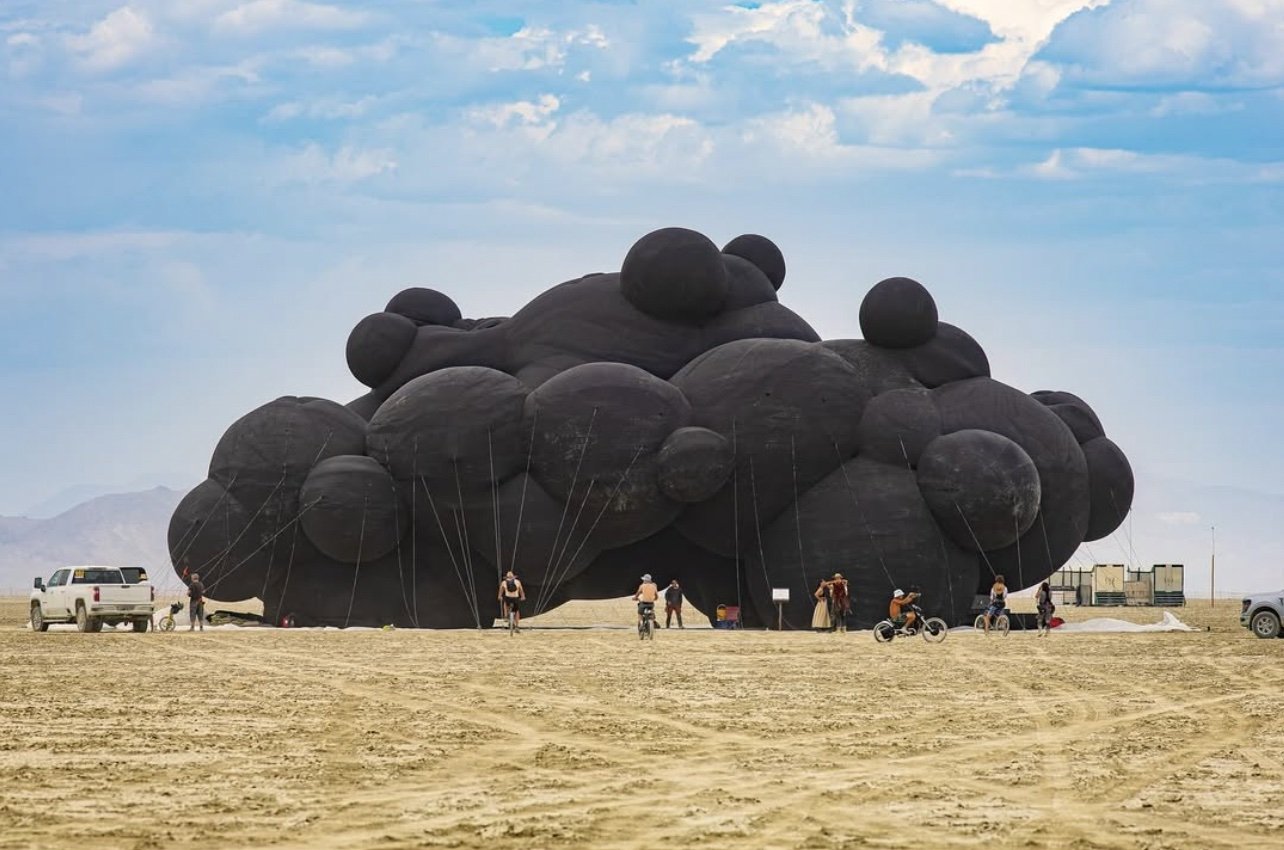
The Black Cloud – Photo via IG, follow @redpilotphotography
With The Point of Unity, Ukrainian artist and lighting designer Mykola Kabluka, founder and art director of Expolight, has created a moment of unity between sky and earth through innovative lighting design. Through intricate reflections, the installation “rooted” the sky into the earth — creating the effect of the sky surrounding visitors from above and below. Integrated sound waves complement the visual experience, creating an atmosphere of calm and focus. “The installation becomes the voice of Ukraine,” Kabluka explained, “speaking through the language of art that unites across borders.”

Point of Unity – Photo by Mattias Löw, courtesy of the artist.
Clayton Blake’s VERTICA soared as a triangular stainless-steel monolith inspired by Brutalist architecture, which served “as both a beacon of progress and a cautionary monument to its consequences.” Its sharp geometry created the illusion of infinite height, while mirrored surfaces reflected visitors and the desert sky in kaleidoscopic distortions. A hidden entrance led to an immersive interior, where a central ladder stretched upward. The glowing chamber animated by shifting LED lights was a metaphor for ambition, progress, and the double-edged nature of technological advancement.
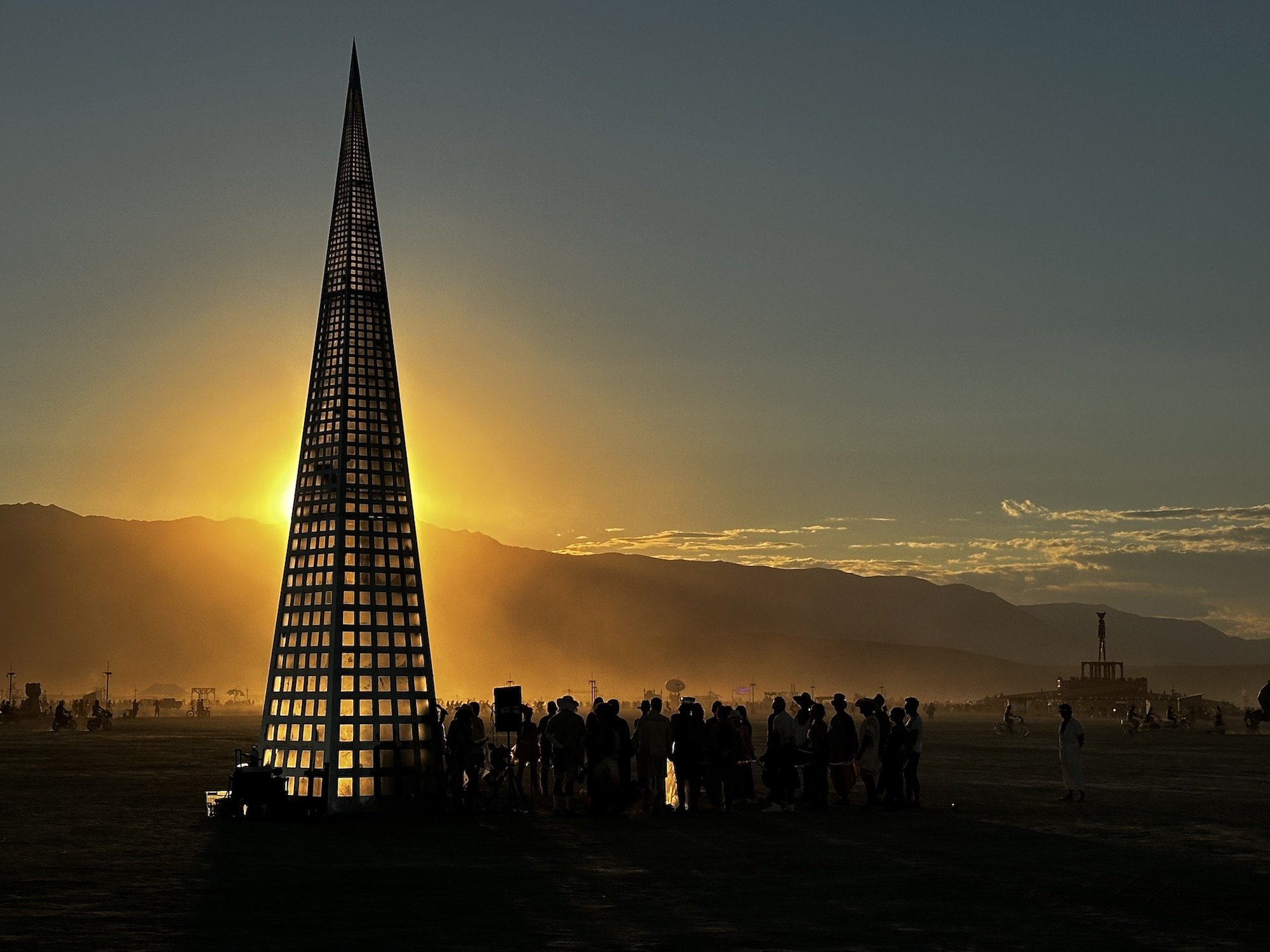
Vertica by Clayton Blake – Courtesy of the artist.
Italian artist Pepemaniak electrified the desert with The Lightning Tower, a jagged neon sculpture resembling a bolt frozen mid-strike. Crafted from hand-blown tubes, the piece cast an ethereal glow across the playa, becoming a modern ritual site where strangers gathered. In an age of digital distraction, its pulsing light invited reconnection — echoing ancient traditions of gathering around fire, but reborn in neon.
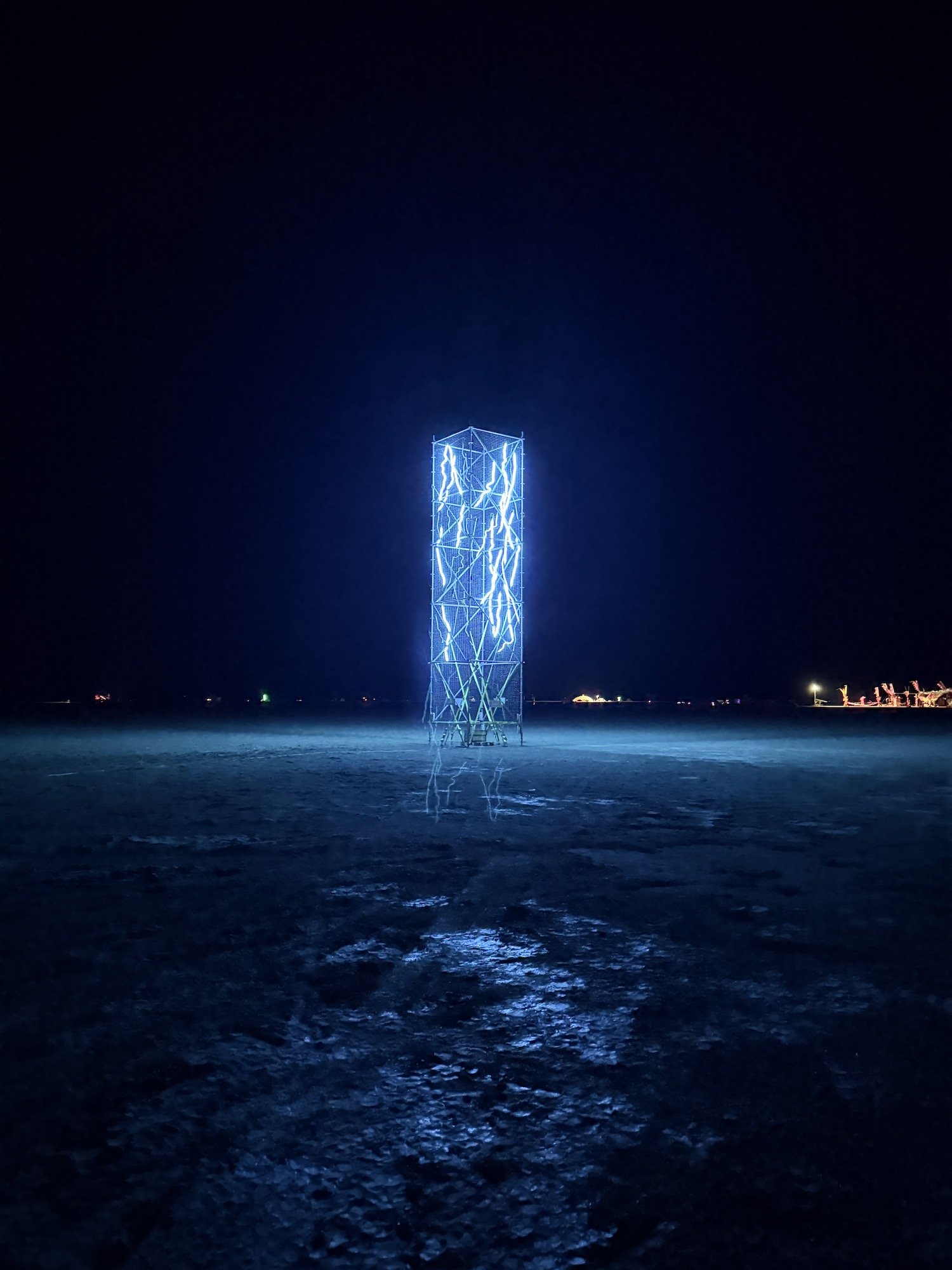
Lightning Tower by Pepemaniak – Photo by the artist.
Ben Bartlett’s Event Horizon brought cosmic wonder to the playa. Five LED-lit concentric rings, up to 20 feet in diameter, spun around a perfectly still infinity-mirror sphere evoking a black hole. The entire gyroscope-like structure reacted to nearby music, pulsing with light and rhythm. At times a sanctuary, at times a dance floor, it invited people to reflect, marvel, and move beneath its shimmering rings.
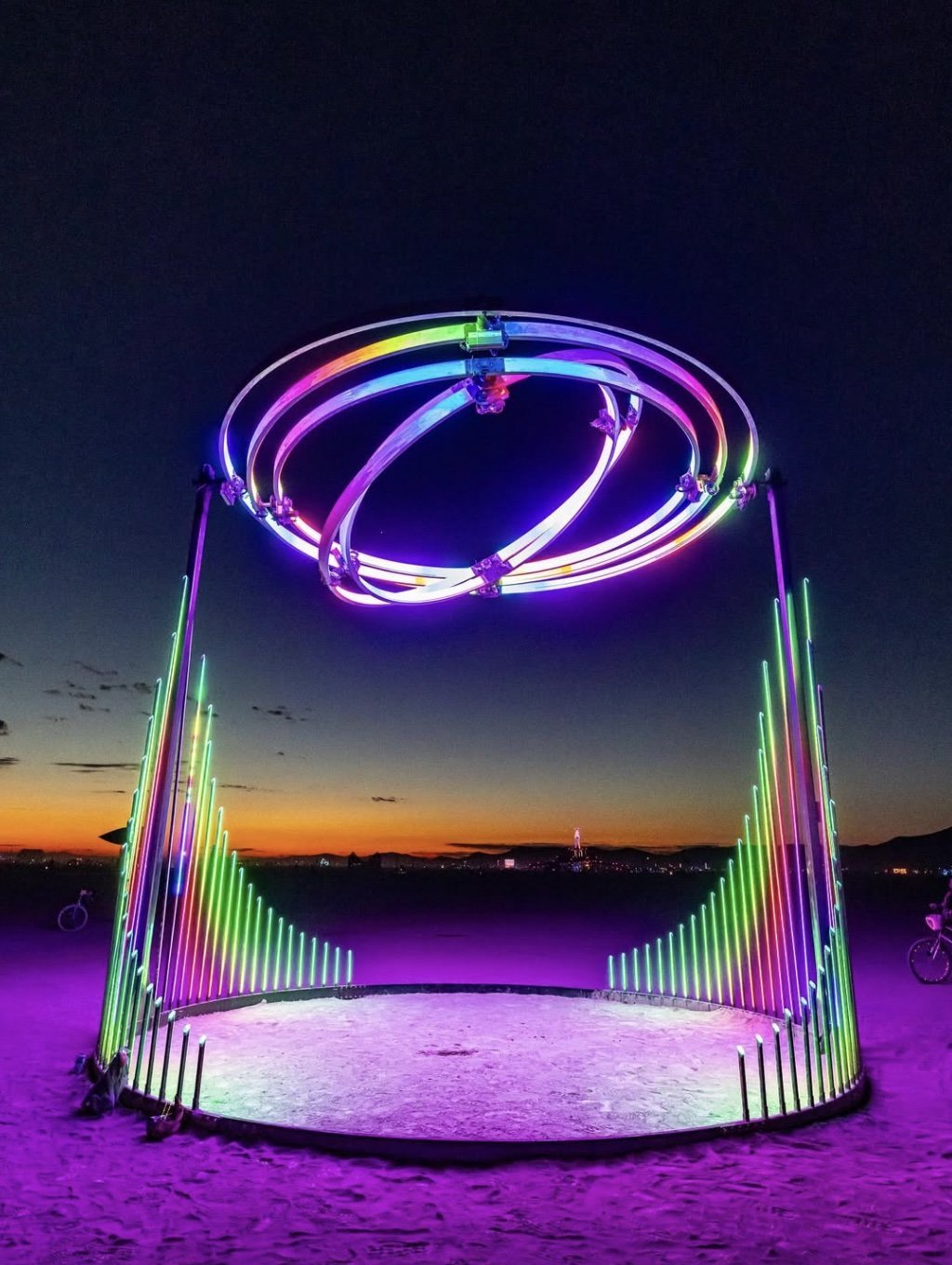
Event Horizon – Photo via IG, follow @redpilotphotography
Raylene Gorum, with Owen Laine and Phil Spitler, created Home Grown: a spiralling timber shell layered with patterns, colour, and light. Its muscular frame contrasted with a delicate, stained-glass-like skin that glowed as visitors moved deeper inside. Shadows and moiré patterns danced across the outer layers, while the inner sanctuary shimmered with radiant colour. “Like the snail’s shell,” Gorum noted, “it shows how we can transform barriers into beauty, carrying sanctuary within us.”
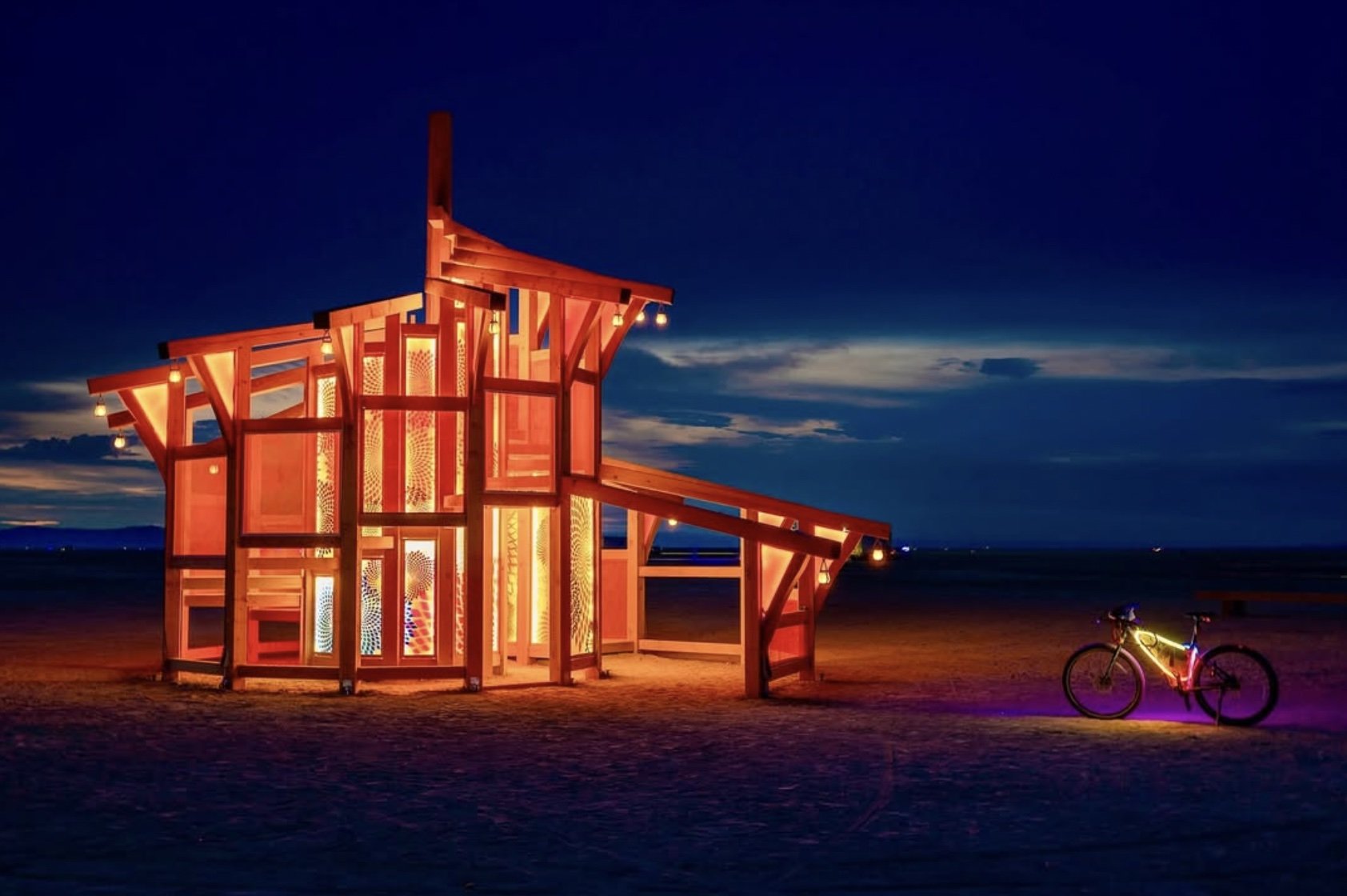
Home Grown – Photo via IG, follow @autobiographica
Spanish architect Alberto Marcos of AMPS Studio spread joy through the “Vessels of Love” installation, shaped like an infinity heart. Visitors climbed and slid across its glowing structure, embodying the work’s spirit of play, connection, and communal happiness. “Love is never linear,” Marcos reflected, “but through it, infinity can be achieved.”
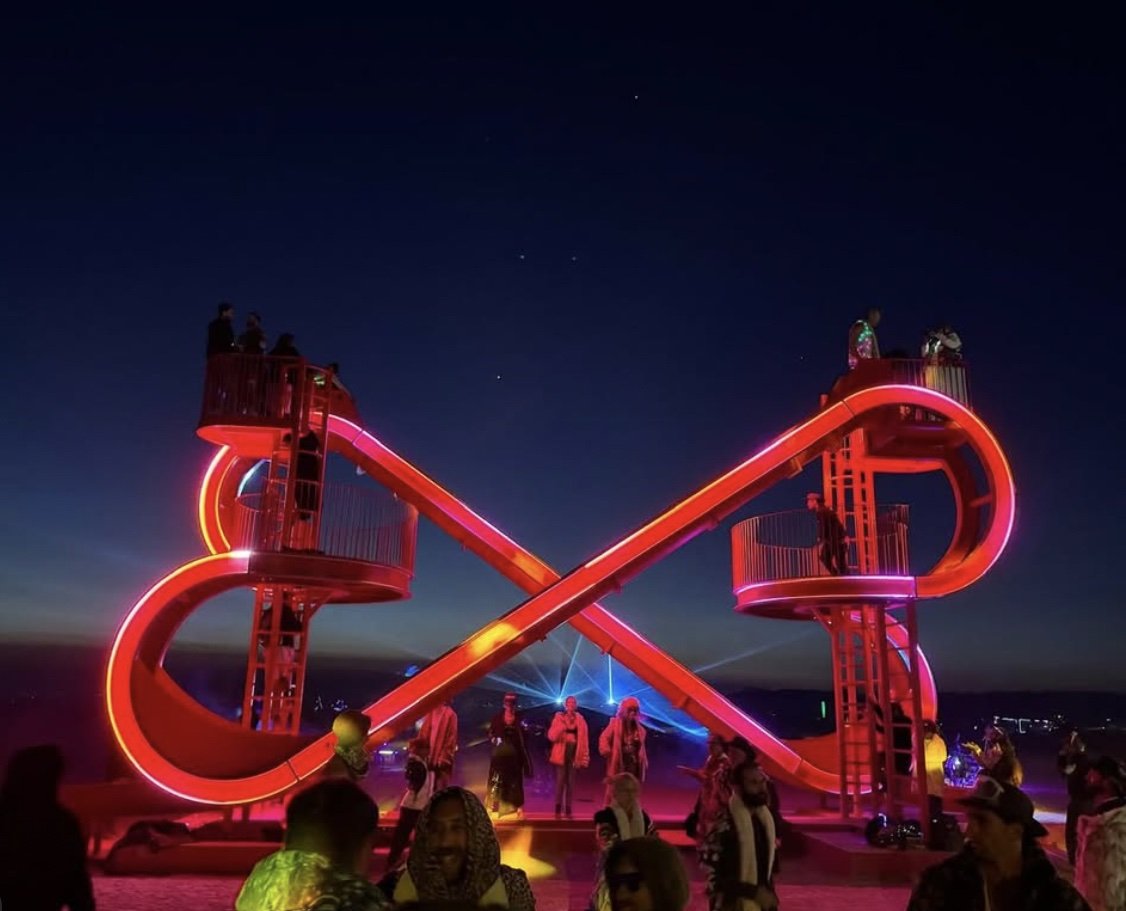
Vessels of Love – Photo via IG, follow alberto_amps
The Moonlight Collective imagined a cosmic ruin with The Moonlight Library. Only one corner of the towering structure remained, its shelves stacked with weathered books whispering forgotten stories to the desert winds. The library served as a metaphor for connection and shared knowledge. Both stage and gathering space, it invited burners to reflect on resilience and empathy. “If we are all books in the same library,” the collective asked, “why do we build walls that divide us?”
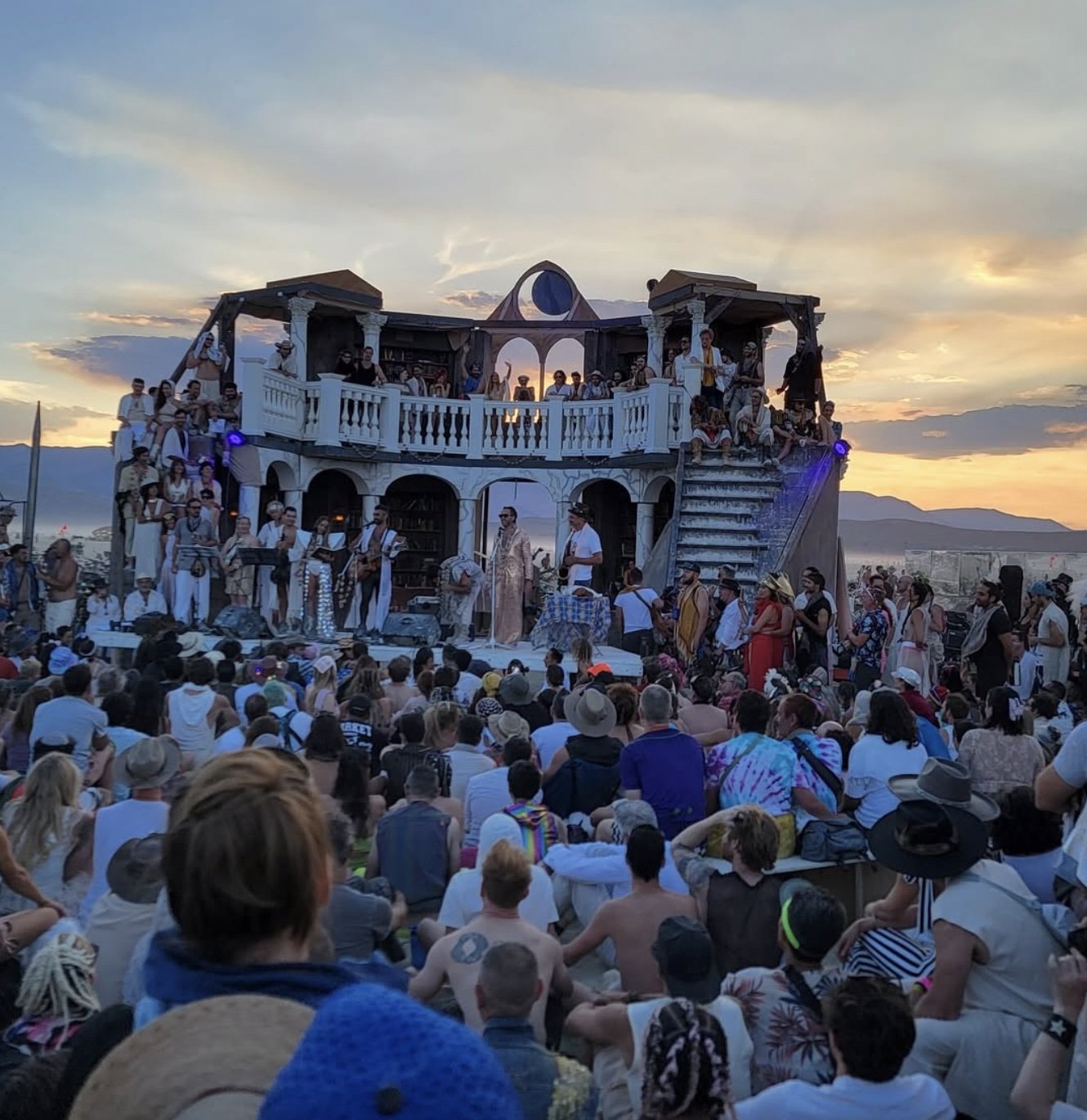
The Moonlight Library at Burning Man 2025 – Photo via IG, follow @the.moonlight.collective