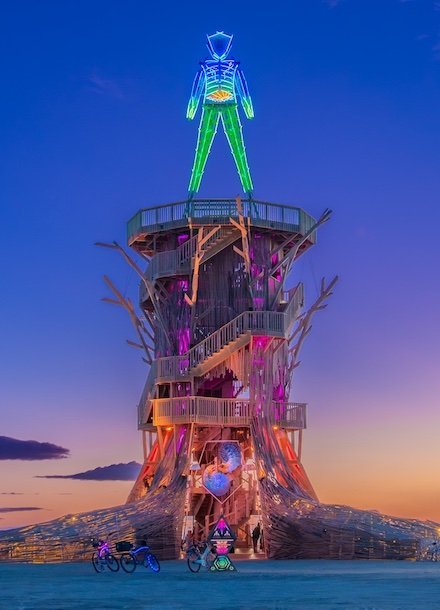
Temple of the Deep by Miguel Arraiz at Burning Man 2025 – Photo by Scott London, courtesy of Miguel Arraiz.
Architecture. Spanish architect Miguel Arraiz brought a powerful vision to the desert: The Temple of the Deep, Burning Man‘s main shrine. Built from wood, lived in, and ultimately burnt to ashes, the temple embodied both strength and fragility. Its cavernous form resembled a fractured black rock—raw on the outside, glowing from within—drawing inspiration from Japanese craft and baroque architecture.
- RELATED STORY: Read more about Burning Man on Archipanic.

Photo by Scott London.
Arraiz describes the project as a place of “radical acceptance,” where people could process life’s depths in their own way. “Our inspiration came directly from nature,” he told Archipanic. “And what better symbol than a large black rock placed in the Black Rock Desert? The design sought to evoke the sense of ancient sacred spaces, blending with the landscape while inviting reflection and contemplation.”

Photo by Scott London.
Indeed, the temple echoed humankind’s oldest sanctuaries—caves, mountains, stone formations—where people have long gathered to seek refuge, explore life’s mysteries, and connect with the earth. Visitors found in it both solitude and community: a shared space where heavy burdens could be released.

Photo by Mark Fromson, @autobiographica.
On a more personal note, The Temple of the Deep was also autobiographical. The fractured black rock glowed from within, its interplay of light and shadow resembling a heart shattered yet still beating. Its scars, Arraiz reminded us, were not flaws but marks of resilience and healing. This philosophy recalled kintsugi, the Japanese art of mending broken pottery with gold, which embraces imperfections as sources of beauty and strength.

Photo by Mark Fromson, @autobiographica.
Inside, the contrast was striking. Beneath a heptagonal dome, the rough exterior opened into a luminous, uplifting interior. Amphitheatre-style seating created space for gathering, while a spiralling vortex of tubing encircled the central opening, aiding ventilation and adding a dynamic rhythm to the structure. Subtle baroque references animated the geometry, guiding visitors through shifting sightlines, flowing movement, and a mesmerising dance of light and shadow.

Photo by Scott London.
Photos by Scott London, Mark Fromson and Miguel Arraiz.

Photo by Scott London.