Suzhou Museum of Contemporary Art by BIG-Bjarke Ingels Group – All photos are by © Ye Jianyuan, unless stated.
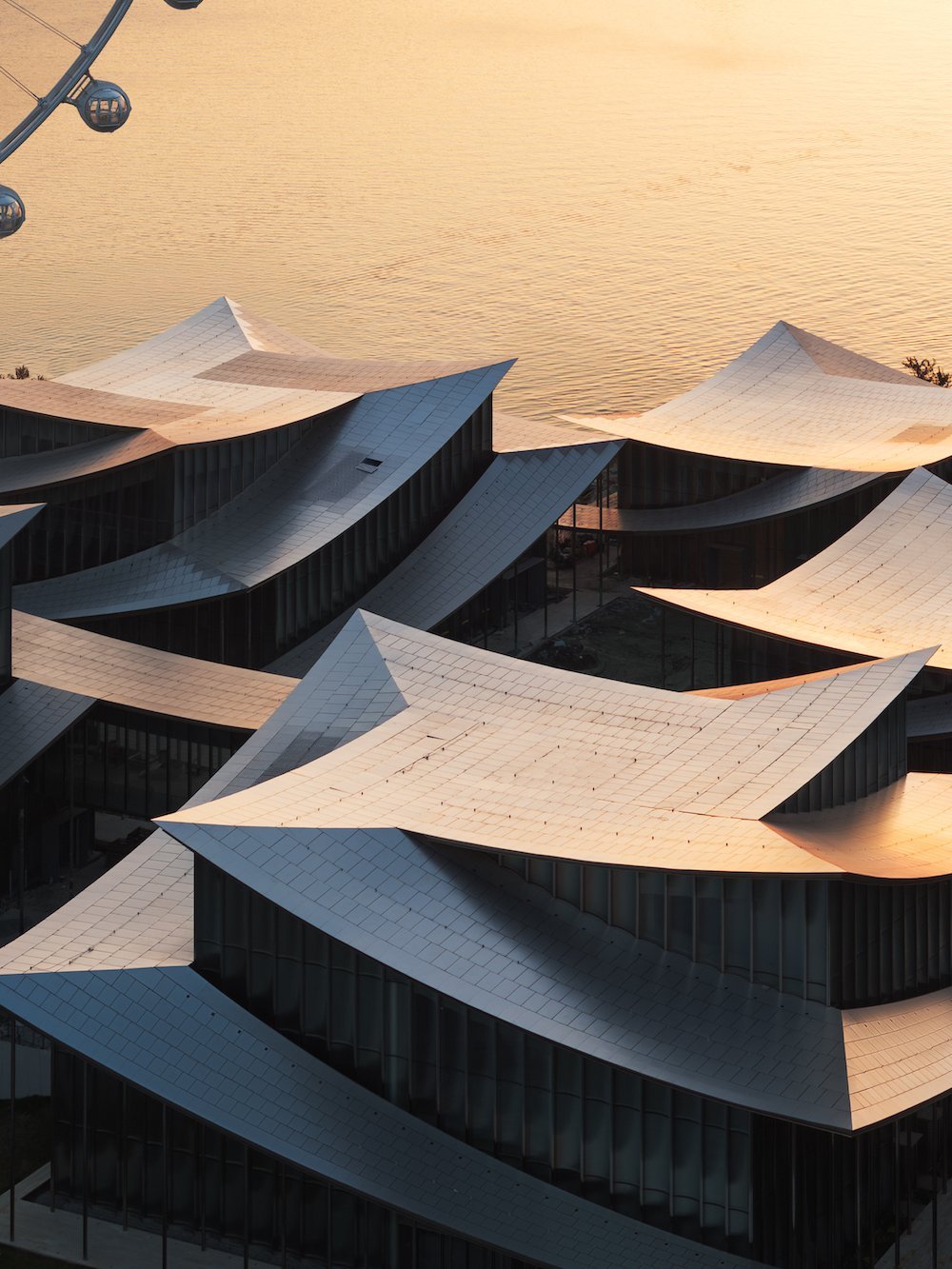
Architecture. The Suzhou Museum of Contemporary Art by BIG—Bjarke Ingels Group, in collaboration with ARTS Group and Front Inc., is part of the city’s development on the Jinji Lake. At its heart lies a sweeping ribbon-like roof whose branching eaves form sheltered walkways across the site. According to the studio, this architectural gesture is a contemporary reinterpretation of “lang” – the long, covered corridors that weave through the Chinese metropolis’s centuries-old gardens.

A large plaza welcomes guests before the Visitor Centre, the museum’s main entrance. From here, they can wander down through the landscaped gardens to the water’s edge. “Weaving between the Ferris panoramic wheel legs, the museum branches out like a rhizome, connecting the city to the lake. The result is a manmade maze of plants and artworks to get lost within,” Bjarke Ingels told Archipanic.

The Suzhou Museum of Contemporary Art comprises four main pavilions dedicated to the gallery programme, while five additional pavilions house a multifunction hall, a theatre, a restaurant, and the grand entrance. These volumes “are woven together by glazed galleries and porticoes, creating a network of interconnected sculpture courtyards and exhibition spaces.”

Each pavilion features sloping roof eaves and curved, rippling glass façades, paired with warm-toned stainless steel that reflects the surrounding planting. Inside, materials such as yellow rust stone, rammed earth, and terrazzo form tactile seating and display elements.

© StudioSZ Photo / Justin Szeremeta.
As BIG notes, “Set against the lake’s open expanse, the soft catenary curves of the roofs create an elegant silhouette along the waterfront. Observed from above, the stainless roof tiles present an authentic fifth facade.”
- RELATED STORIES: Discover more projects by BIG—Bjarke Ingels Group on Archipanic.
© StudioSZ Photo / Justin Szeremeta.
The museum’s landscaping creates a public space at Jinji Lake with interconnected gardens, enhancing the surrounding public realm. Sculptures by contemporary artists provide Suzhou’s citizens with cultural experiences beyond museum hours. Bridges and tunnels link the pavilions above and below ground, allowing seasonal flexibility in curating exhibition flows. As visitors approach the waterfront, the gardens transition from mineral to green to water-themed planting.

Sustainability is woven throughout the project. Passive shading, natural ventilation, and locally sourced materials are incorporated into the museum’s design and construction, achieving China’s GBEL 2-Star Green Building certification.

The museum’s inaugural exhibition, The Materialism, expands on Bjarke Ingels’ year-long guest editorship of the Italian design magazine Domus, in which each issue focuses on a single material. The exhibition explores how stone, earth, concrete, metal, glass, wood, fabric, plastic, plant, and recyclate each shape the firm’s architecture.

© StudioSZ Photo / Justin Szeremeta.
A serene, contemporary landmark, the Suzhou Museum of Contemporary Art invites visitors to explore art, landscape, and architecture as a seamless, ever-shifting journey.

All photography by © Ye Jianyuan, unless stated.


© StudioSZ Photo / Justin Szeremeta.

© StudioSZ Photo / Justin Szeremeta.