Carlo Ratti in Venice – Photo by Andrea Avezzù, courtesy of 2025 Venice Architecture Biennale.
Architecture. From May 10 to November 23, the 19th International Architecture Exhibition in Venice investigates how architecture acts as a catalyst for adaptation and transformation in the face of current social and environmental crises. The Biennale, titled Intelligens. Natural. Artificial. Collective., is curated by Carlo Ratti.
- RELATED STORIES: Read more about the 2025 Venice Architecture Biennale on Archipanic.

Photo by Andrea Avezzù.
Founder of the architecture firm CRA—Carlo Ratti Associati and director of the Senseable City Lab at the Massachusetts Institute of Technology, Ratti is an architect, engineer, and professor renowned for his technology-driven approach, which mixes atoms and bits, data and urbanism, science and architecture, to develop visionary projects for future cities [Read more].
His 2025 Venice Architecture Biennale will showcase projects and installations from over 750 participants to highlight a new collaborative and multidisciplinary approach. Indeed, IntelliGens —a Latin term that merges Intelligence and Gens (people)—has been conceived as a dynamic laboratory that brings together architects and engineers, mathematicians and climate scientists, philosophers and artists, chefs and coders, writers and woodcarvers, farmers and fashion designers, among many others.
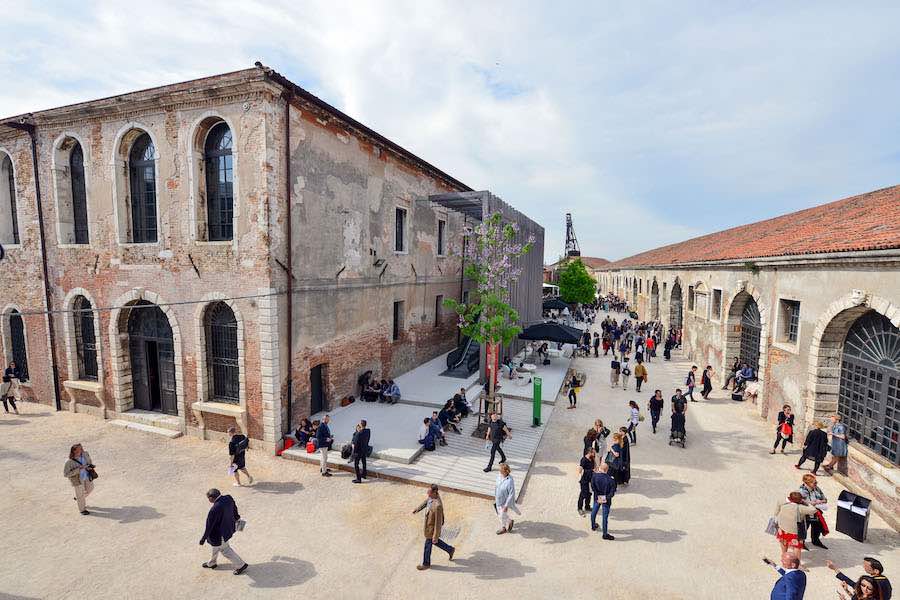
Photo by Andrea Avezzù.
“Architecture has always been a response to a hostile climate. From the earliest “primitive hut,” human design has been led by the need for shelter and survival, driven by optimism,” explains Carlo Ratti. As the climate change emergency entered a new extreme and devastating phase – from the Los Angeles fires to the floods of Valencia and Sherpur – a different approach is needed.
“The time has come for architecture to embrace adaptation. It must draw on all forms of intelligence – natural, artificial, collective – and reach out across generations and disciplines. It must rethink authorship and become more inclusive, learning from science.”

Photo by Giulio Squillacciotti.
In the era of adaptation, Intelligens has forged connections with other global Institutions, such as the UN’s COP30 in Belem, C40, the Davos Baukultur Alliance, the Soft Power Club, and many others. Its public program, GENS, will host a series of events and conversations, engaging audiences of all sizes.
The 2025 Venice Biennale “might not be perfect, but it wants to walk the talk,” explains Carlo Ratti. Most exhibition panels are made of recycled wood – to be shredded at the end of the Biennale and turned into new materials.

Photo by Andrea Avezzù.
All photos and the graphic design below are courtesy of the Venice Biennale.

Intelligens.