

Korean Pavilion “Crow’s Eye View” – courtesy of the Korean Pavilion
Crow’s Eye View, the first exhibiton featuring both North and South Korea, is inspired by a poem by the architect/turned-poet Yi Sang. Curated by Misuk Cho, the Korea’s golden-lion-winning Pavilion at Venice Architecture Biennale underlines the contrast to the singular and universalizing bird’s eye view perspective and points out the impossibility of a cohesive grasp of not only the architecture of a divided Korea but the idea of architecture itself. http://www.korean-pavilion.or.kr/14pavilion/ http://labiennale.org

Korean Pavilion “Crow’s Eye View” – courtesy of the Korean Pavilion
In the immediate aftermaths of World War II, the Korean Peninsula was divided in two. Within Cold War polarizing system, a society and culture that had maintained an unified state entity for more than a millennium evolved two radically, divergent-yet-irrevocably interconnected systems on a economic, political, and ideological perspective.
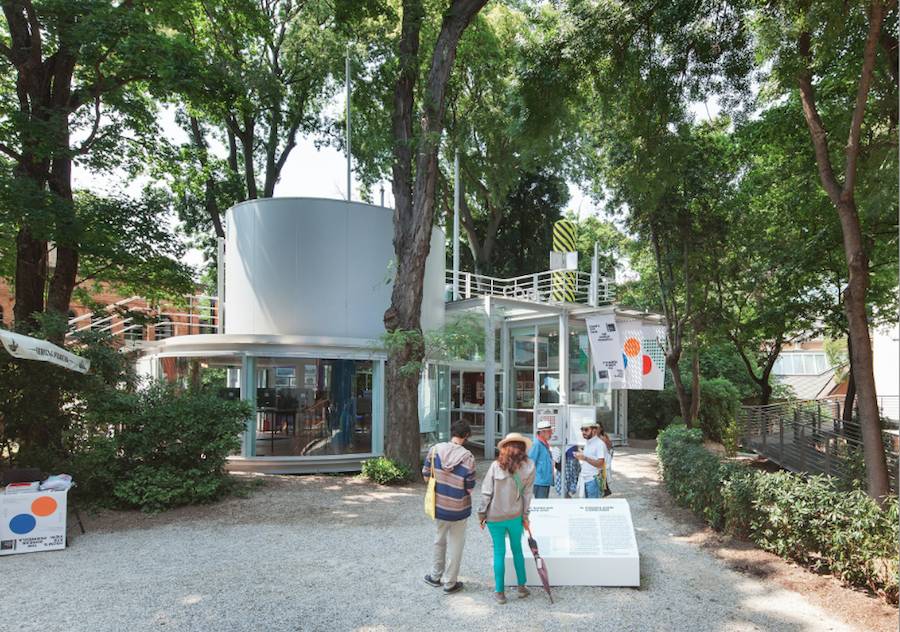
Korean Pavilion “Crow’s Eye View” – courtesy of the Korean Pavilion
The pavilion is divided in four main areas. The first one is Reconstructing life and begins immediately after the Korean War where both South and North Korea were devasted by bombing and destruction.
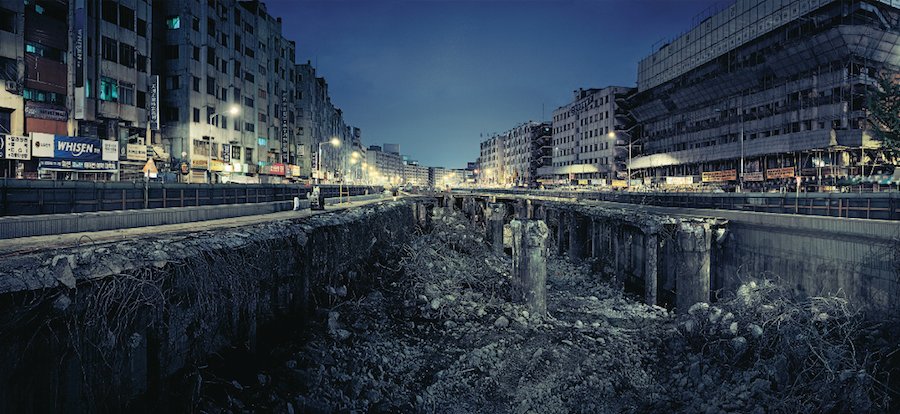
Korean Pavilion “Crow’s Eye View”. Ahn Sekwon, Cheonggye Stream’s View of Seoul Lights, 2004
If old Pyongyang was destroyed by bombs dropped from the sky, the historical landscape of Seoul was destroyed on the ground by bulldozers. After three decades of high state-driven growth, Seoul has become a hybrid metropolitan city. Reconstructing Life takes a glimpse at the common and divergent ways the reconstructed architectural environment of Seoul and Pyongyang.

Korean Pavilion “Crow’s Eye View” – Sejong-ro, Seoul, 2014; photo by Kyungsub Shin © Kyungsub Shin
The second part of the exhibtion is Monumental state and it is focused on monumental architecture in North and South Korea. On a side Pyongyang is the ultimate city of monuments, a city planned upon the ideals of socialism, on the other one, Seoul exploited the values of contemporary globalization.

Korean Pavilion “Crow’s Eye View” – Kim Il-sung Square, Pyongyang, 2010; photo by Philipp Meuser © Philipp Meuser
The third section is dedicated to the DMZ (De-Militarized Zone) border that still divides two once united yet extremely different countries both phisically and politically. The exhibition features an emblematic research on an ecological and social-network level between North and South Korea.
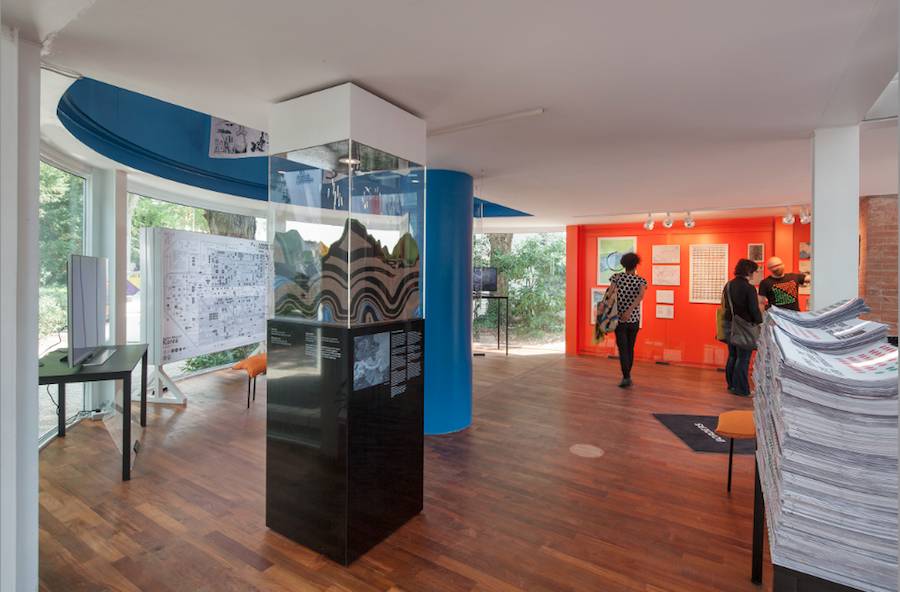
Korean Pavilion “Crow’s Eye View” – courtesy of the Korean Pavilion
The last section is called Utopian tours features Nick Bonner’s selected artwork. Committed to projects that seek to engage with the everyday life of North Korea, Bonner had the chance to visit both Koreas experiencing and developing an extensive, neutral and non-patronising attitude toward the North and South sides of the same peninsula.

Korean Pavilion “Crow’s Eye View” – courtesy of the Korean Pavilion
“The trauma of war and adversarial politics have too often sensationalized and over-simplified this condition, reproducing clichés and prejudices that obscure the complexity and possibilities that lie in the Peninsula’s past, present, and future. In the Korean Pavilion, the architecture of North and South Korea is presented as an agent – a mechanism for generating alternative narratives that are capable of perceiving both the everyday and the monumental in new ways” Comment curator Misuk Cho.

Korean Pavilion “Crow’s Eye View” – courtesy of the Korean Pavilion
Photos: courtesy of The Korean Pavilion at the 14th Venice Architecture Biennale – Video by Venice Architecture Biennale. http://www.korean-pavilion.or.kr/14pavilion/ http://labiennale.org
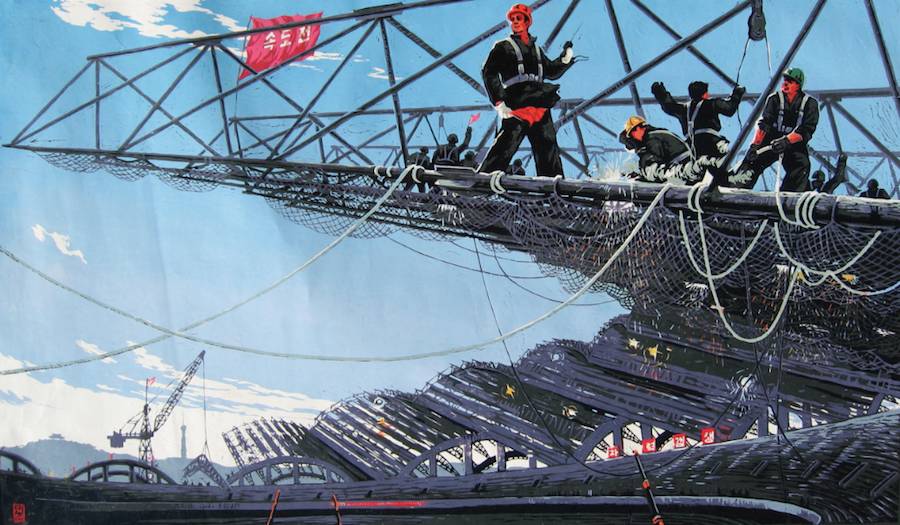
Korean Pavilion “Crow’s Eye View” – Nick Bonner, Linocuts MayDay Stadium.





Comments are closed.