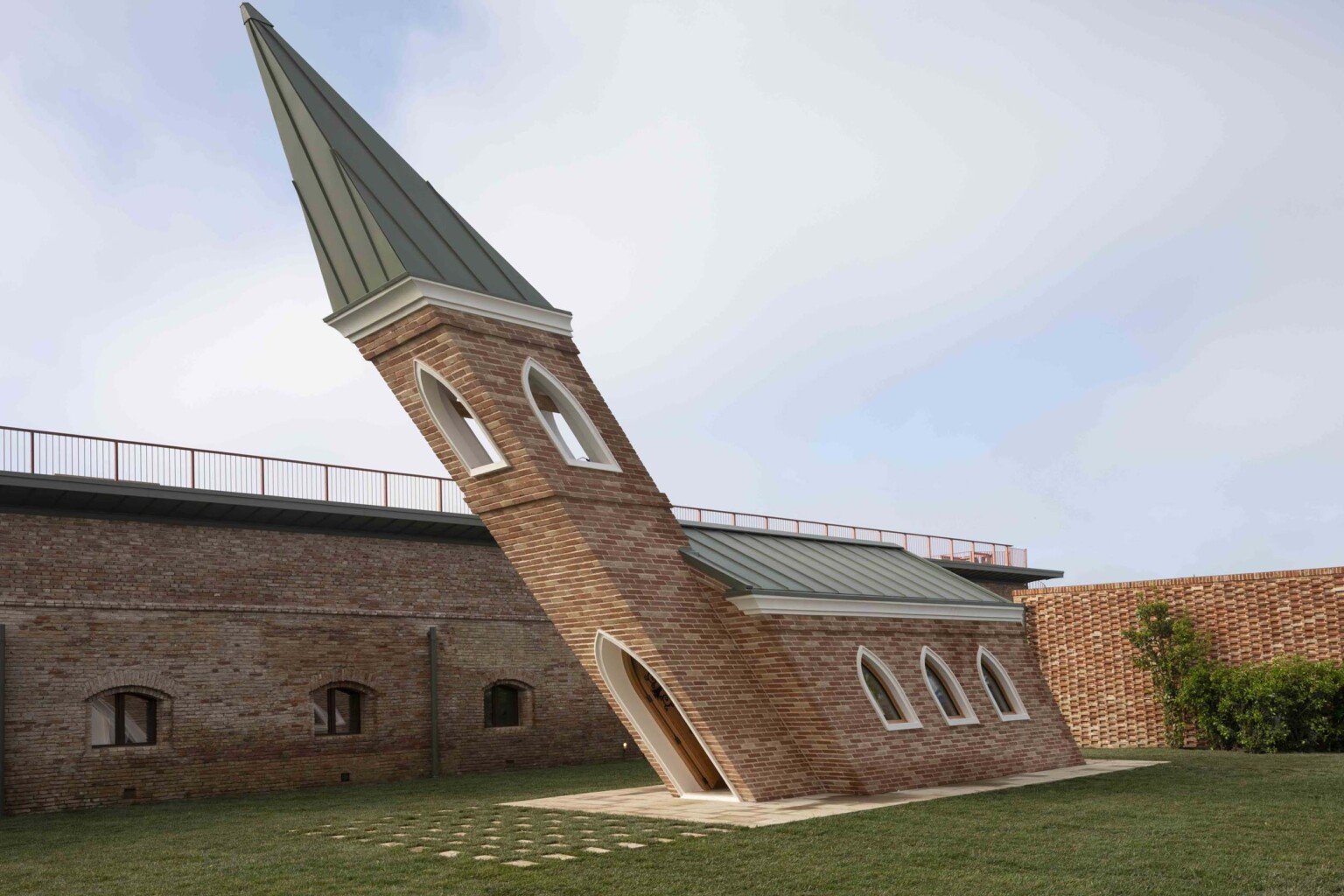
Six surreal architectures in Venice. Huff and Puff chapel by Hugh Hayden – Photo by Jacopo Trabuio.
Art, Architecture. Venice has always thrived on the improbable — a city that shouldn’t exist, built on water, sustained by myth. The 61st International Art Exhibition leans into that logic with remarkable confidence. From tilted chapels to floating synagogues, this year’s Biennale assembles a collection of surreal architectures that feel less like installations and more like arguments: about migration, identity, the limits of form, and what it means to call somewhere home.
- RELATED STORIES: Read more about Venice Art Biennale on Archipanic.

Aguirre y Otegui at Venice Art Biennale 2026 – Photo by Marco Zorzanello.
Hugh Hayden‘s Huff and a Puff at the new Sandretto Re Rebaudengo Foundation centre on San Giacomo island is one of the Biennale’s most immediately legible surreal architectures: a brick chapel tilted forty degrees forward, conjuring the blown-away houses of The Three Little Pigs. Structurally sound and capable of sheltering up to ten people, it was developed using AI. “I worked with a rather archetypal church design, with a bell tower in front, to be able to create a collage of Venetian architecture elements,” says Hayden, who trained as an architect before turning to art.

Photo by Jacopo Trabuio.
Anish Kapoor‘s exhibition at Palazzo Manfrin is perhaps the Biennale’s most ambitious gathering of surreal architectures — around 100 models spanning fifty years are shown alongside large-scale installations. “Sculpture can once again become architecture, and architecture becomes a material to be pushed to its limits.” Built works include the Ark Nova inflatable concert hall and Naples’ Sant’Angelo metro station. Others remain suspended — whether awaiting a brave builder, functioning as technical fantasy, or simply operating as provocation, it isn’t always easy to tell.

Anish Kapoor at Palazzo Manfrin, Venice – © Anish Kapoor.
At the Arsenale, Philip Aguirre y Otegui turns to the gaalgui — the traditional Senegalese fishing boats that have carried so many on clandestine crossings towards the Canary Islands — as the starting point for his monumental architecture. Its sky-blue pigment, borrowed from the painted hulls of those canoes, evokes desire and belief in the future. The work builds into surreal architectures of refuge: the hiding place, the lookout, the lighthouse, each motif folding into a charged and poetic meditation on migration and protection.

Photo by Marco Zorzanello.
The Bahamas Pavilion pays tribute to the late John Beadle. On display are pieces made of cardboard, salvaged objects, Junkanoo costumes, and sailcloth — including the Mobile Housing Scheme. “John, whenever you go, you carry your home — fellow artist and friend Lavar Munroe used to say to Beadle — It’s a wheelbarrow, a space of grounded humility, of labour, identity, and no pretence.”

Photo via IG, follow @thebahamasinvenice.
At the Negozio Olivetti in Piazza San Marco, Carlo Scarpa’s precision-crafted interior dialogues with the unsettling art of Leandro Erlich. As you step inside, a house with roots hangs suspended before the staircase — a miniature version of Erlich’s Pulled by the Roots, the original provocative artwork was a full-scale house dangling from a crane in southwestern Germany. The pieces explore themes of our moment: the ground beneath us, the visual tangle of urbanisation, and the friction between history and modernity. Read more…

HYBRIDS, Leandro Erlich at Negozio Olivetti – Photo by Luca Chiaudano, ©FAI 2026.
Finally, Anna Kamyshan‘s Nabatele — a sixteenth-century Venetian synagogue drifting above the lagoon on a floating rock — is among the most quietly arresting of this year’s surreal architectures. Floating at Arsenale Nord from 16 July, the work reflects Kamyshan’s Ukrainian-Jewish-Russian identity and embodies Yiddishland: a country defined not by borders, but by people, language, and the culture they carry. Read more…
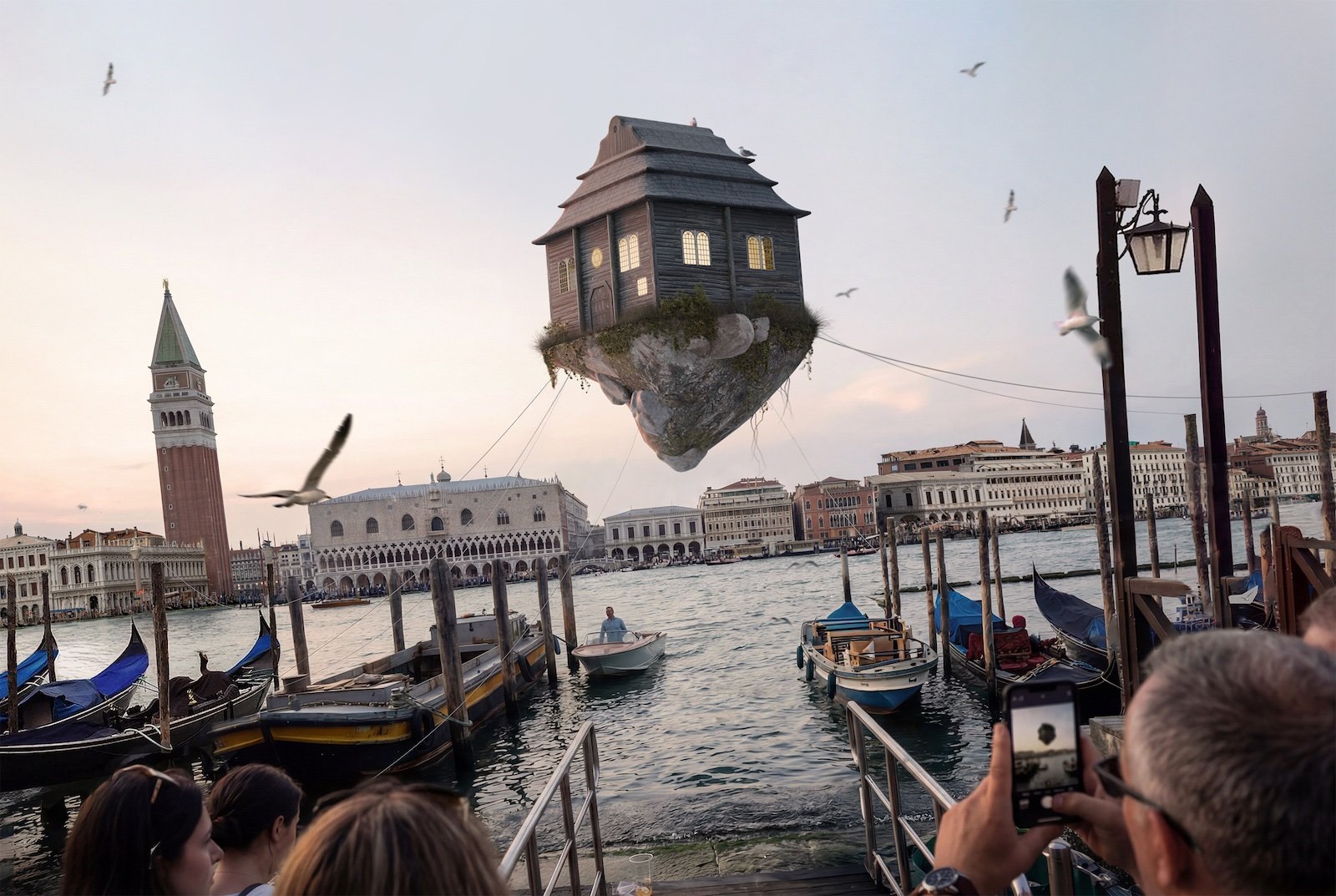
Nabatele. A Floating Synagogue in Venice by Anna Kamyshan – Photo by the artist.

Anish Kapoor at Palazzo Manfrin, Venice – © Anish Kapoor.