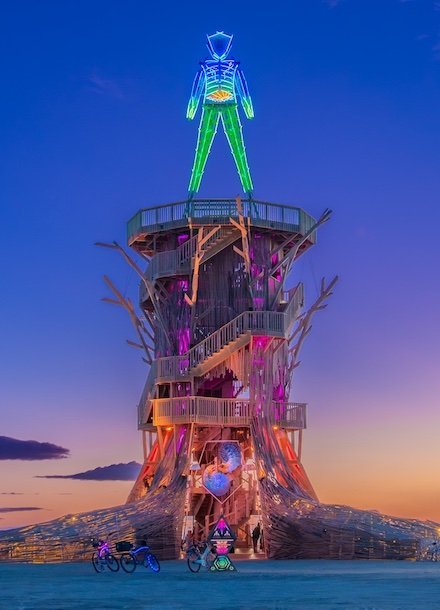
Temple of the Moon by James Gwertzman – Visuals by Annie Locke Scherer.
Architecture. American artist James Gwertzman and his Moonlight Collective have unveiled the design for the Temple of the Moon, the central shrine at Burning Man. The sweeping wooden structure draws its inspiration from the Queen of the Night, a desert cactus that produces one of nature’s more poetic gestures: a single bloom, unfurling after dark, gone before morning.
It’s a fitting muse. “In this act of ephemeral beauty, we find a profound metaphor for our own brief beautiful lives on this planet, as well as for Burning Man itself, which blossoms each year in the dust of the playa, and then disappears without a trace,” explains Gwertzman, who developed the design alongside architectural designer Annie Locke Scherer.

That tension between the fleeting and the enduring runs through every element of the project. “In a world that feels increasingly fast and relentless, the temple offers a quieter counterpoint. A place to slow down, to be with what is here, and to hold space for one another without needing to change a thing.”

Temple of the Moon by James Gwertzman – Visual by Annie Locke Scherer.
A 30-foot central tower anchors the whole composition, its crown fitted with large petals engineered to open each evening and close each morning — a mechanical echo of the flower that inspired it. Glance upward through the tower by day and you’ll find shade; return after dark and those same petals part to frame the night sky.

Threaded up through the centre is a stamen-like form that climbs to 50 feet, lit from within to cast a warm glow across the playa. Five arms curve outward from the base, looping back on themselves to create quieter, more sheltered pockets within the larger whole.

Getting there is part of the experience. Twenty detached petal-shaped walls are positioned around the perimeter in a way that rules out any direct approach. Visitors are instead guided through a series of deflected turns — a spatial sequence that owes something to the monumental corridor works of Richard Serra.

It behaves in part like a Serra corridor, compressing the body between planes, bending the line of travel, and slowing the visitor down so they arrive at the temple with an increased sense of presence and shifted sense of time. The outer boundary is marked by a circular fence spanning 220 feet, with eight gates set into it — one for each phase of the moon.

Behind the scenes, the whole design was built parametrically, with algorithmic tools doing much of the generative heavy lifting and pushing the creative process well beyond what traditional drafting could achieve.

There’s something quietly radical about a structure designed to make you slow down. The Temple of the Moon promises to be one of those rare spaces that stays with you long after the playa dust has settled.

All visuals are by James Gwertzman and Annie Locke Scherer.