Liu Jiakun, 2025 Pritzker Prize – Photo courtesy of The Hyatt Foundation-The Pritzker Architecture Prize.
Human Architecture. “The purpose of architecture is to create a beautiful, just, and dignified living environment,” believes Liu Jiakun, the 2025 Pritzker Architecture Prize, the Nobel equivalent for architecture. His career spans over four decades, with projects ranging from academic and cultural institutions to civic spaces, commercial buildings and urban planning throughout China.
- RELATED STORIES: Read more about the Pritzker Architecture Prize on Archipanic…

West Village, Chengdu – Photo courtesy of Qian Shen Photography.
Liu Jiakun, the 54th Laureate of the Pritzker Architecture Prize, is the third Chinese architect to be awarded this honour. Each of his projects emphasises social reality, local context, and vernacular craftsmanship, aspiring to address modern architectural challenges through a realistic approach inspired by folk wisdom.
“First you need to be a person, then an architect.” Continues Liu. “You shouldn’t impose your habitual fixed sense of form, technical posture, or design inertia in advance. You need to think about what the object wants to become.”

Luyeyuan Stone Sculpture Art Museum, Chengdu – Photo courtesy of Bi Kejian.
“Through an outstanding body of work of deep coherence and constant quality, Liu Jiakun imagines and constructs new worlds, free from any aesthetic or stylistic constraint,” states the 2025 Jury Citation. “Instead of a style, he has developed a strategy that never relies on a recurring method but rather on evaluating the specific characteristics and requirements of each project differently.”
Liu once said, “I always aspire to be like water – to permeate through a place without carrying a fixed form of my own and to seep into the local environment and the site itself.”

Songyang Culture Neighborhood, Lishui – Photo courtesy of Arch-Exist.
Liu was born in 1956 in Chengdu, China. In 1982, he graduated from the Institute of Architecture and Engineering in Chongqing–now Chongqing University—and began his career at the state-owned Chengdu Architectural Design and Research Institute. In 1999, he founded Jiakun Architects.

Museum of Clocks, Chengdu – Photo courtesy of Bi Kejian.
Liu designs public spaces in crowded cities where space is often limited to support the breadth of requisites for a diverse society. For example, his Chengdu West Village (2015) spans an entire block, including pathways for cyclists and pedestrians to envelope a vibrant city of cultural, athletic, recreational, office and business activities.
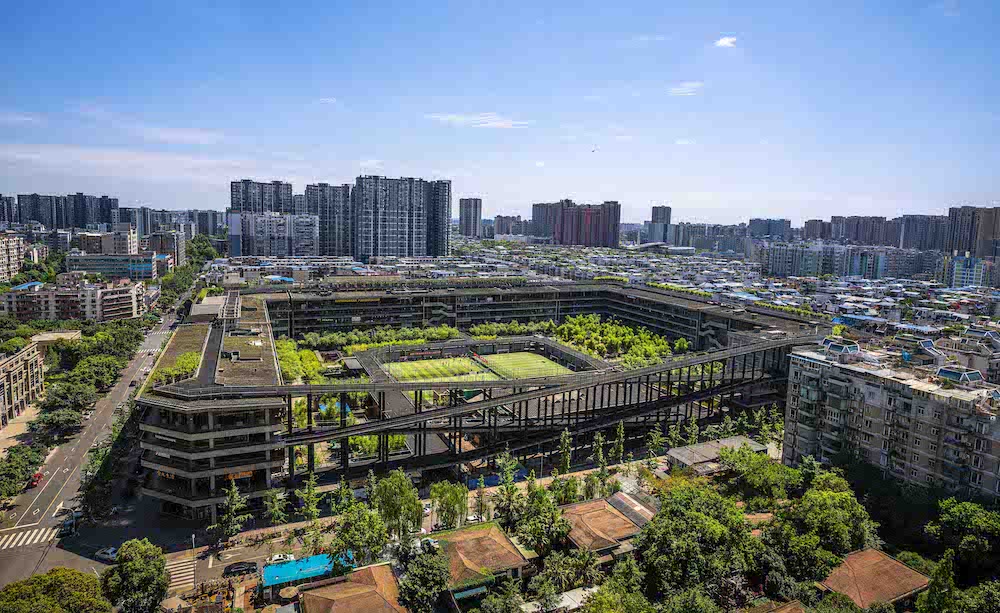
West Village, Chengdu – Photo courtesy of Chen Chen.
“Cities tend to segregate functions, but Liu Jiakun takes the opposite approach and sustains a delicate balance to integrate all dimensions of the urban life,” comments Alejandro Aravena, Chair of the Jury and 2016 Pritzker Prize Laureate. He continues, “In a world that tends to create endless dull peripheries, he has found a way to build places that are a building, infrastructure, landscape and public space at the same time. His work may offer impactful clues on how to confront the challenges of urbanisation, in an era of rapidly growing cities.”

Novartis (Shanghai) Block-C6 – Photo courtesy of Arch-Exist.
Throughout his works, Liu demonstrates a reverence for culture, history and nature through modern interpretations of classic Chinese architecture. The flat eaves of the Suzhou Museum of Imperial Kiln Brick (China, 2016) reimagine the form of pavilions dating back many millennia. The tiered balconies of Novartis Block – C6 (Shanghai, China, 2014) are reminiscent of towers representing many dynasties. The Luyeyuan Stone Sculpture Art Museum (Chengdu, China, 2002) is modeled after a traditional Chinese garden.

Suzhou Museum of Imperial Kiln Brick, Suzhou – Photo courtesy of Arch-Exist.
Liu Jiakun’s architectural work highlights the genuine qualities of textured materials and techniques, showcasing enduring imperfections that withstand the test of time. He prefers traditional craftsmanship over manufactured goods, often incorporating raw local materials that benefit the local economy and environment, crafted for and by the community.

Renovation of Tianbao Cave District of Erlang Town, Erlang – Photo courtesy of Arch-Exist.
All photos: courtesy of the Pritzker Architecture Prize.

Department of Sculpture, Sichuan Fine Arts Institute, Chongqing – Photo courtesy of Arch-Exist.