‘Traces’ exhibition by Majeda Alhinai for the first Oman Pavilion at Venice Architecture Biennale – All photos are courtesy of the Sultanate of Oman.
Architecture. The Sultanate of Oman debuts at the Venice Architecture Biennale with the Traces exhibition by architect Majeda Alhinai and William Virgil. Rooted in the principles of the Sablah, Oman’s traditional gathering spaces, the pavilion explores how heritage and contemporary design intersect to create adaptable and resilient communal spaces.
- RELATED STORIES: Read more about the 2025 Venice Architecture Biennale on Archipanic.
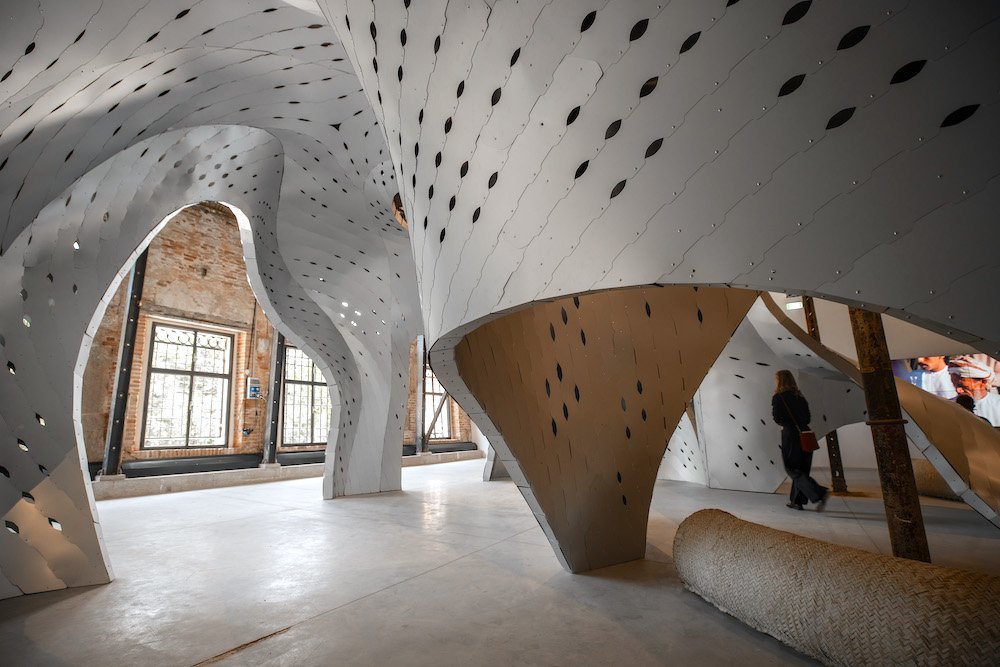
The Oman Pavilion invites visitors to pass through, linger, and come together beneath a striking, sinuous structure with no thresholds or enclosures, nor singular axes of movement. Entirely made from raw aluminium, the architecture is formed through a custom system of folded and cut panels. Alhinai digitally abstracted patterns, ceremonial knives, carved wooden doors and other elements usually found in Sablahs to create a parametric architecture with contemporary geometries.

The design draws inspiration from Oman’s traditional communal spaces. As old neighbourhoods transform into modern cities, the Sablah remains a cultural bridge between tradition and modernity, embodying Oman’s identity, resilience and hospitality.

“Traces offers a spatial framework built from the cultural intelligence of Omani practices,” explains Majeda Alhinai. “It shows how architecture can emerge from inherited systems of making, maintenance, and adaptation. The pavilion is not a symbol of tradition. It is a working model for how civic space can be reimagined through embedded knowledge.”

The Sablah’s spatial and social qualities, open circulation, shared presence, adaptability, and hospitality are translated into architectural terms. The pavilion applies this embedded logic to propose a new type of civic space that remains rooted in cultural specificity while addressing global questions of collectivity, reuse, and architectural responsibility.

Indeed, the entire assembly was conceived to be transported and reassembled in its entirety. Every component, from the substructure to the skin, has been designed for disassembly without material loss. The structure will be permanently installed in Oman following the Biennale, maintaining its scale and function as a civic space.

All photos are courtesy of the Sultanate of Oman, Ministry of Culture, Sports and Youth for Culture.
- RELATED STORIES: Discover more architecture and design from Oman on Archipanic.