Natural Intelligens section of the 2025 Venice Biennale – Photo by Andrea Avezzù, all photos are courtesy of La Biennale di Venezia.
Architecture. At the start of the 2025 Venice Biennale‘s main exhibition at the Arsenale, Carlo Ratti suggests that the future of architecture isn’t about controlling nature, but working with it. In the Natural Intelligence section, you’ll find inspiring projects that imagine cities where plants are part of the infrastructure, natural materials are renewable and circular, and humans share space with insects, animals, and other species. “Biomimicry reminds us that the smartest designs are those shaped by millions of years of evolution,” says Ratti. “Can we imagine a building as smart as a tree?”
- RELATED STORIES: Read more about the Venice Biennale 2025 on Archipanic.

Necto – Photo by Marco Zorzanello.
“We’re sharing just a few highlights from the ‘Natural Intelligens’ section—think of them as a teaser,” says Enrico Zilli, founder and Editor-in-Chief of Archipanic. “Carlo Ratti’s selection is rich, inspiring, and absolutely worth a deeper dive. What you read here is just the tip of the iceberg!”
PLANTS

Architecture as Trees, Trees as Architecture – Photo by Marco Zorzanello.
Architecture as Tree – Tree as Architecture by OLA (Office for Living Architecture) reimagines trees as active parts of buildings. In this project, trees are gently guided to grow around technical joints, forming living structures like treetop walkways. It’s a creative blend of nature and design, where roots and branches become architectural elements. The installation explores how trees can help shape buildings that adapt to seasons, manage water and energy, and evolve over time. By fusing the living with the built, the project invites us to think differently about how we design with nature, not just around it.
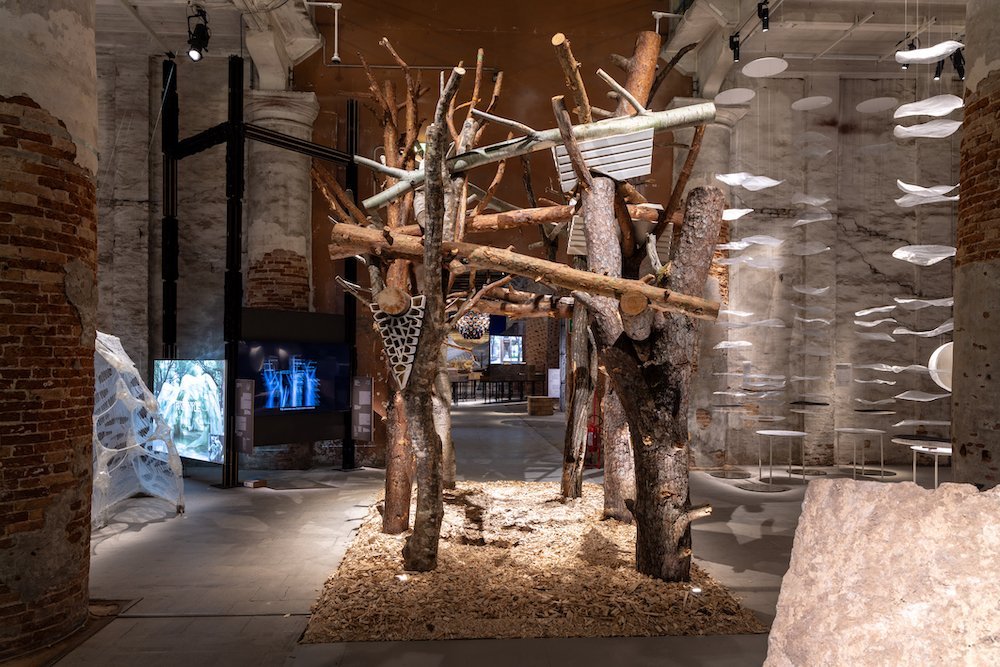
Domino 3.0 Generated Living Structure – Photo by Marco Zorzanello.
A few months back, a huge storm swept through Northern Italy, leaving behind piles of fallen trees and broken branches. Instead of letting all that wood go to waste, Kengo Kuma & Associates and the University of Tokyo came up with a smart and sustainable idea. They transformed the storm debris into sturdy structures, utilising custom 3D-printed soft joints to secure everything together. It’s a creative way to turn natural leftovers into something useful. With further development, the Domino 3.0 Generated Living Structure project could even help build safe shelters in emergency situations, starting with what nature provides.

Fabbrica dell’Aria – Photo by Luca Capuano.
Neuroscientist Stefano Mancuso and PNAT scientists and architects present La Fabbrica dell’Aria (Air Factory), an installation that harnesses the intelligence of plants to purify indoor air. Acting like a “breathing biomachine,” it uses the patented Stomata® system to channel air through a substrate where plant roots and beneficial bacteria break down pollutants.
ANIMALS & BACTERIA

The Other Side of the Hill – Photo by Marco Zorzanello.
Several projects explore natural ecosystems as an opportunity to create more biophilic cities in collaboration with other species. The Other Side of the Hill examines the future of our growing global population by looking at the tiny microbial communities that help manage how we use resources. Designer Patricia Urquiola brings this idea to life through a thoughtful spatial experience that blends science, math, and design in a creative and engaging way.

The Living Orders of Venice – Photo by Marco Zorzanello.
As our cities grow and natural spaces shrink, architecture needs to evolve to welcome not just people, but wildlife too. With The Living Orders of Venice, Studio Gang partnered with the citizen-science app iNaturalist to create tiny homes for the Biennale’s smallest residents—bees, bugs, and other little critters, making space for nature in the heart of the city.

FundamentAI – Photo by Luca Capuano.
ecoLogicStudio and the Synthetic Landscape Lab present FundamentaAI, a project that sees Venice’s foundations as a living part of the lagoon. By giving voice to its microbiome, it turns the city’s base into an active, shape-shifting landscape, like a slime mould that reacts to its surroundings.

Sea Oasis – Photo by Marco Zorzanello.
AI can also help scientists preserve and encourage biodiversity. The Sea Oasis exhibition by DotDotDot focuses on combating Mediterranean species loss through algorithmically designed, 3D-printed oyster reefs monitored by the University of Padua.
NATURAL MATERIALS

Necto – Photo by Luca Capuano.
“Architecture should shift from a model of extraction and waste to one of reuse and regeneration.” Said Carlo Ratti. SO–IL’s Necto is a playful textile pavilion that blurs the line between soft and solid. It embraces the beauty of ambiguity in today’s design world. Made from DNA-encoded yarns and bio-resin, the structure stretches, stiffens, adapts, and eventually disappears without leaving a trace.

Elephant Chapel – Photo by Marco Zorzanello.
Elephant Chapel by Boonserm Premthada is a playful yet thoughtful take on sustainable building. Instead of using tons of traditional materials, the team asked: How can we create a strong, durable structure that’s also lightweight and resource-efficient? Their answer? Bricks made from elephant dung. The result is a beautiful arched pavilion, over 3.5 meters tall, built from reinforced dung bricks and set on a sturdy steel base. It’s surrounded by a brick-paved garden, also made from the same surprising material. Designed as a space for elephants, this clever structure is quite literally by elephants, for elephants.

Circularity Handbook – Photo by Marco Zorzanello.
A team led by the Chinese interdisciplinary studio PILLS created a Circularity Handbook kinetic mandala that merges low-tech and high-tech approaches to reimagine building materials, construction processes, and domestic systems through circular principles.

Earthen Rituals – Photo by Luca Capuano.
Lola Ben-Alon’s Earthen Rituals blends the power of AI with the wisdom of traditional materials deeply connected to human stories. By turning the textures of earth into digital code, the project transforms construction waste and agricultural leftovers into beautiful 3D-printed earth-fibre tiles. Created as a space for reflection, Earthen Rituals invites us to rethink extractive habits, reckon with colonial histories, and face climate challenges, offering instead a more ceremonial, mindful approach that celebrates the natural quirks and beauty of raw materials.

CONQ, Marine biobased building materials – Photo by Marco Zorzanello.
Each year, over 10 million tons of shells—from oysters, clams, scallops, and mussels—get tossed away, even though they’re packed with valuable calcium carbonate. The CONQ project, led by Angie Dub and Heidi Jalkh, sees potential in this so-called waste, transforming it into a sustainable building material. By mixing crushed seashells with algae-based biopolymers, the result is a bioceramic made entirely from marine biomass—no heat required, and all naturally sourced.
[su_image_carousel source=”media: 44143,44145″ limit=”0″ slides_style=”minimal” crop=”none” columns=”2″ spacing=”no” captions=”yes” dots=”no” autoplay=”1″ speed=”immediate”]
All photos are courtesy of the 2025 Venice Biennale.

Natural Intelligens section of the 2025 Venice Biennale – Photo by Andrea Avezzù, Courtesy La Biennale di Venezia.