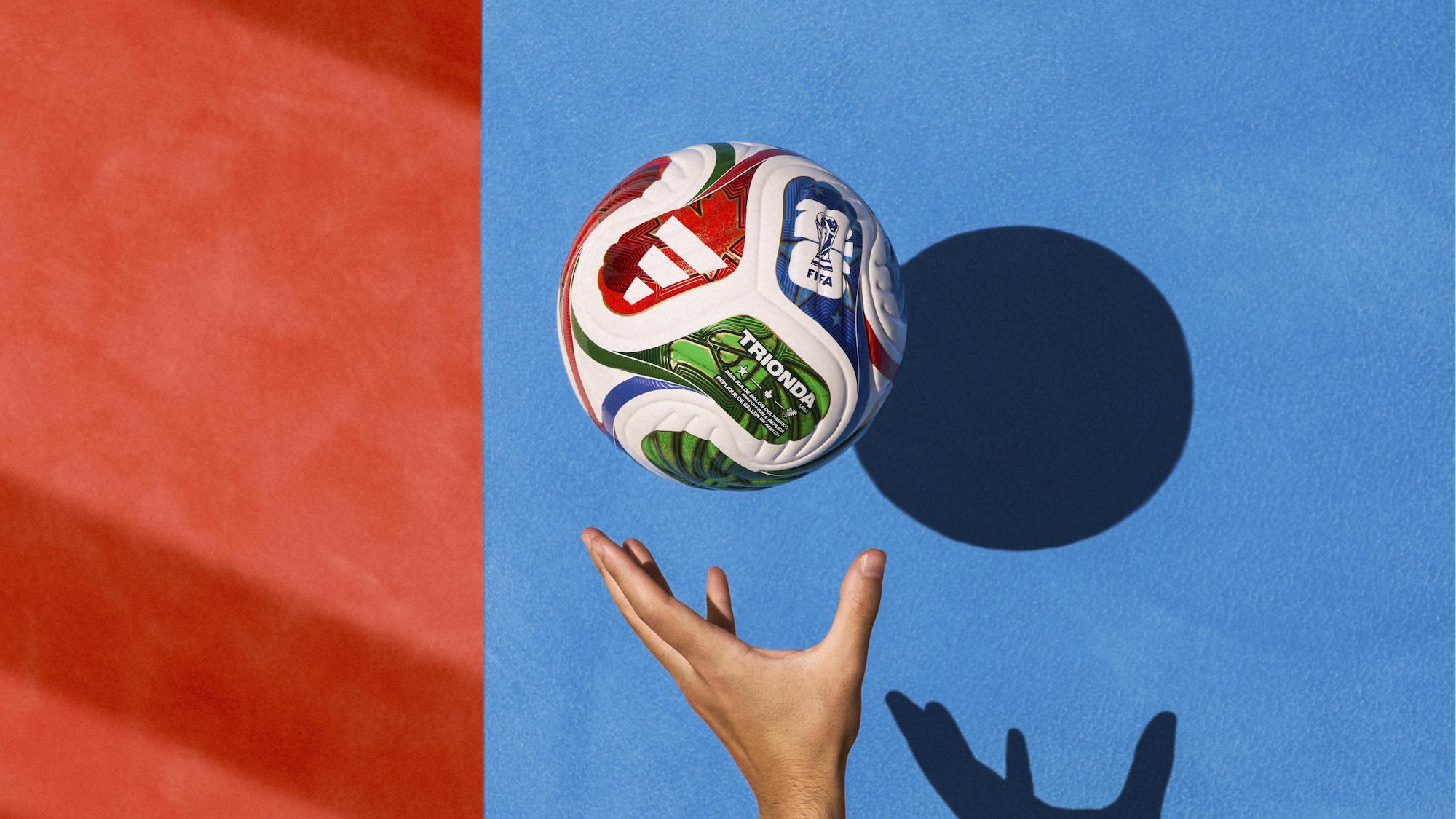
Adidas’ Official Match Ball of the FIFA World Cup 2026 – Photography is by Adidas.
Design. For the first time, three nations — Canada, Mexico and the United States — come together to host the FIFA World Cup, and the Adidas-designed Official Match Ball reflects that with a striking design and a new side-mounted chip system. “As soon as the tournament hosts were announced, we knew we had to make something special – a ball that can be played everywhere, from the world’s biggest stage to the backyard,” says Solene Stoermann, Category Director at Adidas.
- RELATED STORIES: Read more about the architecture and design of the FIFA World Cup 2026.

Jude Bellingham poses with the FIFA World Cup Ball.
Named TRIONDA — Tri for three, Onda for waves — the match ball introduces a brand-new four-panel construction built with performance in mind. Its fluid geometry echoes the waves nodded to in the name, while each panel carries the host nations’ colours: red for Canada, blue for the US, and green for Mexico, meeting in a triangle at its centre.

Lionel Messi dribbles with the FIFA World Cup Ball.
Each country also gets its own emblem: a star for the USA, a maple leaf for Canada, and an eagle for Mexico. These appear as punchy graphics across the panels and are subtly embossed into the matte base, lending the surface a fine, all-over texture. Gold detailing rounds things off as a quiet nod to the World Cup trophy itself.

“With TRIONDA, every detail has an impact,” says Sam Handy, General Manager at adidas Football. The Official Match Ball is “a piece of craftsmanship built for the biggest stage, that makes you want to hold it, admire it, and above all, play with it.”

On the performance side, the four-panel build relies on deliberately deep seams and carefully placed debossed lines, working alongside the embossed icons to keep the match ball stable mid-flight by spreading drag evenly as it travels. Adidas also says the textured surface gives players an “elevated grip” when striking or dribbling in wet or humid conditions.
This match ball also carries the next step in Adidas Connected Ball Technology, swapping the old centre-mounted setup for a new side-mounted chip system. The 500Hz inertial measurement unit now sits within a dedicated layer built into one of the four panels, rather than being suspended at the core.

Lamine Yamal poses with the FIFA World Cup ball.
That shift gives unprecedented insight into the ball’s every movement, feeding precise data straight to the Video Assistant Referee system in real time. Paired with player positioning data and a touch of artificial intelligence, it helps officials reach offside decisions more quickly. Built in close partnership with Kinexon, the technology also helps officials pinpoint each touch on the match ball, cutting down the time spent untangling tricky incidents — handball calls included.

The technology within the FIFA World Cup ball.
Taken together, TRIONDA feels like a fitting symbol for football’s first tri-hosted World Cup — three colours, three icons, one match ball built to perform under serious scrutiny. Whether it’s being tracked by VAR or just kicked about for fun, this is a design that backs up its looks with real substance.


Photography courtesy of Adidas.
- RELATED STORIES: Discover more sport-related design and architecture.