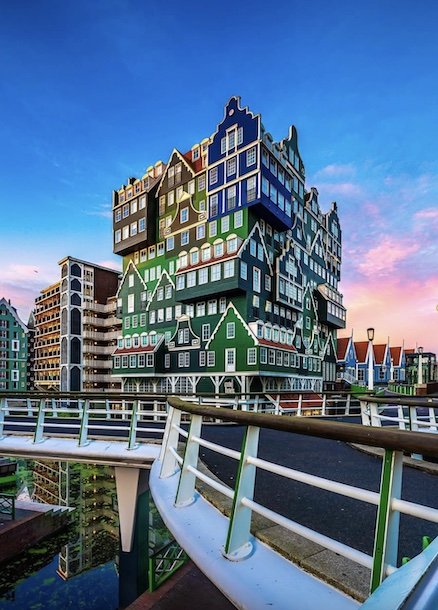
IKEA’s Swedish market at IKEA’s Food for Thought exhibition in Milan – Courtesy of IKEA.
Design. IKEA and food have always been quietly inseparable. “No one buys furniture on an empty stomach,” the company’s founder, Ingvar Kamprad, once said — and he meant it literally. Back in 1960, the furniture giant opened its first in-store restaurant in Älmhult, setting a precedent that a warm meal and a welcoming space go hand in hand. Decades later, that same conviction took on a bold new shape during Milan Design Week 2026.

Kitchen by Lydia Chan and Alessandra Lauria.
For the occasion, the Swedish furniture giant presents Food for Thought, nestled in Spazio Maiocchi [via Maiocchi 7, Map] within the Porta Venezia Design District — a Milanese neighbourhood that has long had a knack for attracting creative energy. The participatory exhibition, brought to life by architect Midori Hasuike and spatial design studio Emerzon, wove together design, food, and conviviality into something that felt less like a brand activation and more like a genuine cultural conversation.

Mikael Axelsson’s inflatable chair at IKEA’s Food for Thought exhibition.
At its core, the project is a sensory journey grounded in the everyday — five environments, each born from a dialogue between a designer and a chef, each asking the same quiet question: how are our eating habits and social rituals reshaping the spaces we call home?

Living room by Maye Ruiz and Rosio Sanchez.
Across different cultures and contexts, food emerges as both a design language and a catalyst for human connection, which is rather the whole point of Food for Thought. Each of the five spaces carried its own atmosphere. Maye Ruiz and Rosio Sanchez played with the living room’s dual nature — part sanctuary, part impromptu gathering spot.

Dining room by Mehek Malhotra and Maurizio Tentella.
In the dining room, Mehek Malhotra and Maurizio Tentella treated the shared meal as one of the most loaded and meaningful social rituals we have. Lydia Chan and Alessandra Lauria rethinks reimagined the kitchen as a place where children aren’t just welcome but central to the act of cooking.

Bedroom by Charlotte Taylor and Ben Lippett.
Charlotte Taylor and Ben Lippett nudged the familiar boundaries of mealtimes: “What if breakfast in bed, lunch among pillows, and dinner with a tray on your lap became everyday habits?” And Oliver Lyttelton with Tina Choi reframed solitary eating in a studio living space — not as something to get through, but as a small, deliberate act of self-care.

Studio living by Oliver Lyttelton with Tina Choi.
Running through it all was a large central kitchen, buzzing with tastings and live performances put together by five creative duos — the beating heart of an otherwise contemplative exhibition. Outside, the courtyard took on the character of a Swedish saluhall, the traditional covered market, with local producers sharing space alongside IKEA Food staples. And tucked among them, a rather unexpected detail: Chupa Chups lollipops flavoured after IKEA’s legendary meatball.

IKEA’s Swedish market at IKEA’s Food for Thought.
The exhibition also served as the stage for new arrivals from the 10th edition of IKEA’s PS programme for democratic design. Lex Pott designed a metal floor lamp from a single cylindrical tube, cut at a diagonal to create a clean angled joint — the top section rotates to direct the light wherever it’s needed.

Lex Pott’s lamp.
Marta Krupińska‘s rocking bench does exactly what it sounds like, its generously curved runners setting the whole seat into a gentle, unhurried sway. Mikael Axelsson rounded things off with an easy chair built from inflated cylindrical cushions — oversized and cloud-soft, yet light enough to shift across a room without effort.

Marta Krupińska’s rocking bench.
The final stop is the BILLY Café, a space that borrowed its spirit from IKEA’s most beloved bookcase and filled it with 1,000 cookbooks selected by Phaidon. A fitting full stop to a journey that had, from beginning to end, treated food as something far richer than sustenance.

Billy Café.
Because that, in essence, is what Food for Thought set out to say: that design doesn’t stop at furniture, and that the way we eat — who we eat with, where, and how — says rather a lot about who we are.
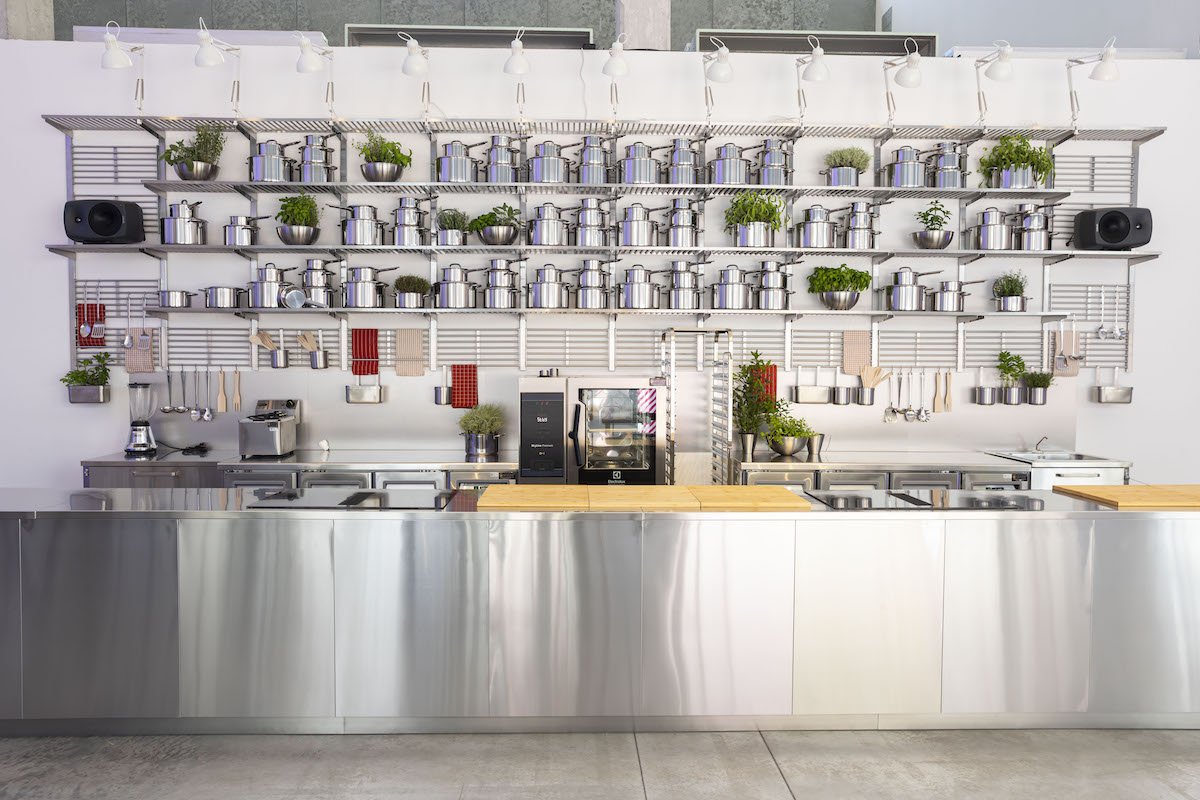
Hero Kitchen..
All photos are courtesy of IKEA.

Hero Kitchen.