

Social issues and business opportunities. Sustainable visions and public budget management. What future awaits London and Londoners? Shall we feel doomed by Alain de Botton‘s warnings or feel reassured by Renzo Piano and Eric Parry‘s sustainable towers that aim to dialogue with historical low-rise neighbourhoods? Shall we dream of garden bridges like Thomas Heatherwick and Joanna Lumley or mourn the death of London public realm as Sir David Chipperfield suggests?

With over 260 towers under construction across the city. Both critics and Londoners debate about the vertical spree in town. Supporters remind that the new skyscrapers attract investments, create jobs, enhance the image of the city worldwide, rebalance the needed urban density, are high-quality and sustainable. Others underline that neighbourhoods are becoming more and more expensive pushing out its inhabitants.

Is London loosing its own character and people in name of big investments? We collected comments and points of view of the protagonists of London transformation.
RELATED STORIES: Read more about architectural skyscraping on ArchiPanic.

After The Shard, London tallest skyscraper, reknown Italian architect Renzo Piano is set to build the next tower in town. The 65 storey high cilindrical building is part of Paddington redevelopment that aims to redefine the importance of the station as a key gateway to get into town.

The proposal features over an acre of public realm at its heart but will also host quality retails and an elegant plaza with restaurants and cafes. The new Paddington Place will “increase connectivity, create jobs and drive much-needed investements” say developers Great Western Developments Ltd and Sellar Property Group.

“The creation of urban public realm has been at the forefront of our design” assures Renzo Piano. On the other side, Sir David Chipperfield said to The Guardian that he regards private investment’s hold over new architecture in London as an “absolutely terrible” means of building a city.

“We have declared the public realm dead” said the leading British architect “The question is how to get stuff out of the private sector”. According to Chipperfield, London’s architecture lacks the sense of culture of Berlin where he has been working on major projects such as Neues Museum.

In the meantime the City keeps rising. Over a month ago PLP Architecture got a go-ahead for 22 Bishopsgate, a 62 storey and 278-m. high office tower that was supposed to be the tallest skyscraper of the financial district. But, few weeks later, Eric Parry Architects unveiled the design of 1 Undershaft, the ultimate higest tower in the City squeezed between “gherkins” and “cheese graters”.

22 Bishopsgate by PLP Architecture will host office space for about 12.000 people. It will also integrate a restaurant and a bar occupying the upper levels, a public viewing gallery offering free entry, and art venues enriching the public realm experience.

The 73 storey and 309.6-metre high development at 1 Undershaft by Eric Parry Architects will tower over the new cluster of planned skyscrapers in the financial district. The proposed building includes the creation of a large public square at the base of the tower and a free public viewing gallery, an education centre and a restaurant at the top of the tower.

Eric Parry says “1 Undershaft will reconnect the city’s tall building cluster with the public and set new standards for the City in terms of comfort, quality and environmental sustainability. The City of London is proving it can yet again attract international investment in creating unique and important new buildings”.

In their latest update, Rafael Viñoli Architects expressed their satisfaction for the “Best Commercial High-Rise Architecture” prize given by the International Property Awards program to the 20 Fenchurch Street skyscraper.

This year, the tower that friends (and enemies) call Walkie Talkie, was also bestowed by Building Design Magazine with the Carbuncle Cup for the worst building of the year.

Due to its convex mirrored shape facing downwards the building used to act like a giant lens burning cars like ants and frying eggs on the pavement. But it also managed to almost blow pedestrians into the road “thanks” to a rather embarassing wind problem caused by its unusual shape.
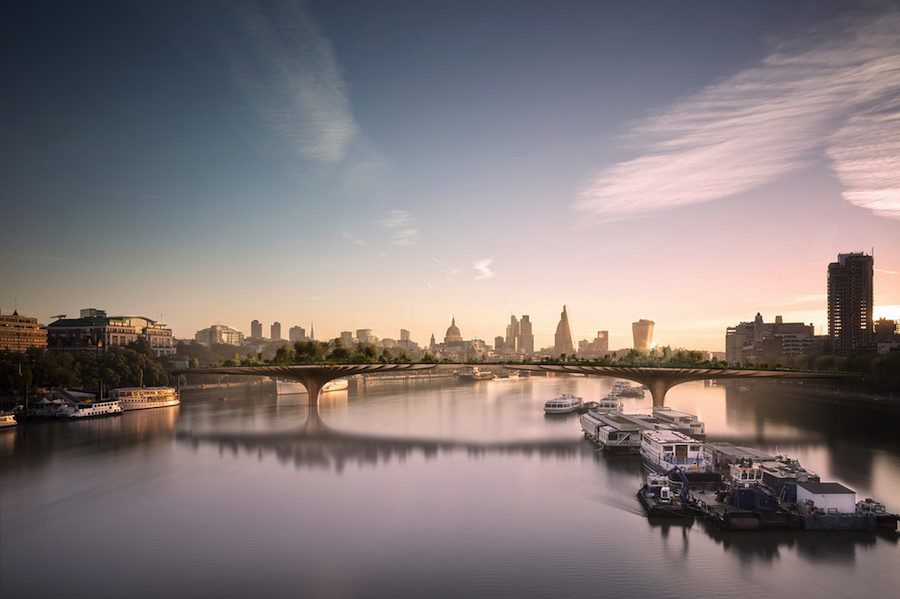
Big plans extend onto the the river Thames as well. Thomas Heatherwick proposal for the 366 m. long Garden Bridge got a green light. The much debated design would bring a relaxing and bucolic environment with chirping birds and buzzing bees to all Londoners. The footbridge linking Temple underground on the Northbank to the South Bank aims to increase London cutting edge attitude attracting tourists with a new sustainable landmark.
Actress Joanna Lumley backed Heatherwick’s sustainable vision trying to convince London mayor Boris Johnson to realise the architectural dream she has longed for London for so much time. After the green light, the project that will cost about £175 million and it will be the most expensive footbridge of the world, has been clearing technical hurdles all year long. Construction site will eventually start next spring.


Which will be the future of London? In 2015 all issues and challenges became clear. Professionals and Londoners became well aware of what’s at stake. Let’s just hope the upcoming year will bring good news.

RELATED STORIES: London transformation according to reknown designers like Tom Dixon, emerging talents, established galleries and local craftsmen.





Hi All im newbie here. Good article! Thx! Love your stories!
Nice post! Thank you.