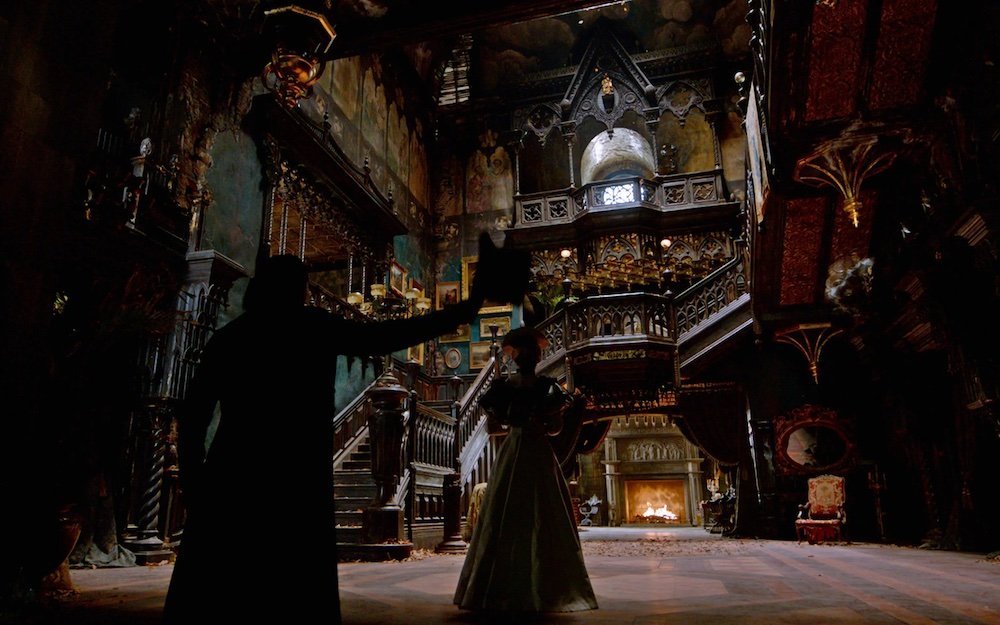
Twelve architectural haunted houses in movies and TV series. A scene from Crimson Peak by Guillermo del Toro, 2023 – Courtesy of Universal.
Architecture, Interior Design. “Some houses are born bad,” says the narrator in the trailer of The Haunting, 1963. Whether they are fancy mountain hotels in Colorado, neglected brutalist buildings in Tokyo, Gothic Revival mansions or Frank Lloyd Wright’s masterpieces, these evil and bone-chilling haunted houses are the real protagonists of some of the best cult horror films and TV shows.
- RELATED STORIES: Discover spooky architecture and design, from Victorian haunted houses to ghostly chairs.
The Haunting
Robert Wise, 1963.
Inspired by The Haunting on Hill House, a gothic horror novel by American author Shirley Jackson, the movie follows the misadventures of a group of paranormal investigators exploring a Neo-gothic mansion with a tragic past in Massachusetts.
The exterior corresponds to Ettington Park, a High Victorian country house built in the 1860s in Warwickshire. The claustrophobic interiors were shot in a Victorian-Rococo style at MGM-British Studios. Doors are not centred, walls are constructed with angles askew, corridors are distorted, rooms are cluttered. Filmaker Robert Wise even used anamorphic lenses to disorientate and alter perspectives.
The Amityville Horror
Stuart Rosenberg, 1979.
Reality and fiction blend into The Amityville Horror, the quintessential haunted house film. The house is not just a setting but a character itself, a villain with triangular attic windows glowing like the eyes of some possessed jack-o-lantern. The movie follows a middle-class young couple who purchase a home haunted by combative supernatural forces.
The original house, a Dutch Colonial Revival home built in Amityville, 30 miles outside of New York City, was the actual scene of a grisly murder in 1974 when 23-year-old Ronald J. DeFeo Jr. murdered his entire family while they were asleep. A few years later, new owners reported spine-tingling tales of paranormal activity and the building became America’s Most Haunted House.
The Shining
Stanley Kubrick, 1980.
Meet Jack Torrence (Jack Nicholson), an alcoholic novelist with writer’s block who takes a job as a winter caretaker at the Overlook Hotel in the Colorado Rocky Mountains with his family. Based on Stephen King’s eponymous book, The Shining is about rampage and hallucinations.
King based the Overlook Hotel on the Stanley Hotel, a 140-room Colonial Revival hotel in Estes Park, Colorado. The exterior shots were filmed at the Timberline Lodge in Oregon, a rustic architecture with a Native American influence. All indoor sets were recreated and filmed at Elstree Studios in England. The set design of Kubrick’s masterpiece doesn’t rely on claustrophobic and dark spaces but on high ceilings, luxury interiors and lonely expanses. Characters are frequently dwarfed by gigantic columns, huge windows and never-ending carpets.
Poltergeist
Tobe Hooper, 1982.
Forget creaking stairs, mysterious basements, and Victorian Gothic interiors. Poltergeist is set in a California dream house in an idyllic suburban neighbourhood. “The house looks just like the one next to it and the one next to that.” Here, a happy family’s newly built home is invaded by malevolent ghosts that abduct their youngest daughter.
By bringing the haunted house sub-genre into present-day America, the cult movie profoundly impacted a new generation of horror films, from The Sixth Sense to the Nightmare on Elm Street saga, Paranormal Activity, and The Ring.
Beetlejuice
Tim Burton, 1988.
Beetlejuice is about haunted ghosts living within surreal architecture. Set in an isolated Victorian house on the top of a hill, and even in its building’s model, the movie reverses the usual point of view. Indeed, the house is haunted by unscrupulous people who aim to turn it into a tourist attraction and profit from the resident ghosts’ presence. The protagonists (Micheal Keaton, Geena Davis, Winona Ryder, Alec Baldwin) create doors by drawing lines on the walls. In the attic a diorama of the house and the village all0ws the to cross multiple dimensions.
Sitting on the top of a hill, the Victorian-esque building features turrets and porches and resembles Norman Bates’ mansion in Psycho. The interiors are rich and over the top: a ragged stone table with ultra thin high-back chairs, a chunky fire place, wacky furniture and trippy and sculptural tableware. Fancy a shrimp cocktail?
The Others
Alejandro Amenábar, 2001.
The Others tells the story of Grace (Nicole Kidman) and her two photosensitive children living in a lonely mansion enveloped by fog on the British island of Jersey just after World War II. The manor seems to be haunted by poltergeist-like presences and a great mystery. “No door should be open before locking the previous one,” warns the protagonist. The final twist is stunning.
“I wanted to make a film full of long, dark corridors, a tribute to those beings, never unmasked, that stalked the hallways of my boyhood nightmares.” Explained filmaker Alejandro Amenábar. The actual building is Palacio de Los Hornillos, an English-style manor in rugged Cantabrie, a city on the misty Atlantic Coast of Spain. The interiors were specially created on a soundstage in Madrid. Here, Amenábar and production designer Benjamin Fernandez customed design the dark halls and hidden corners from which surprises emerge.
Dark Water
Hideo Nakata, 2002.
In the late ‘90s, a new wave of Japanese horror movies freaked the world out with dark-haired pale ghosts intruding on fancy contemporary apartments. But Dark Water was different. The movie tells the story of a divorced mother (Hitomi Kuroki) who moves with her daughter into a rundown apartment complex in Tokyo. Here, they experience supernatural occurrences, including a mysterious water leak from the floor above.
The film is set in one of the many neglected postwar brutalist buildings where some of the poorest people actually live. Dark Water also aims to raise awareness of contemporary Japan’s lower-class poor living conditions.
American Horror Story: Murder House
Ryan Murphy, 2011.
The first season of the acclaimed series American Horror Story centres on the Harmon family, who move to a mansion in Los Angeles, unaware that the ghosts of its former residents and their victims haunt the house.
Designed by architect Alfred Rosenheim in 1908, the historic building in Gothic Revival style has been the set of many movies and TV series, including Alfred Hitchcock Presents, Dexter, The X Files, and Buffy The Vampire Slayer. The interiors were recreated in studio exactly like the original building and feature Tiffany stain glass and Peruvian mahogany panelling.
Hereditary
Ari Aster, 2018.
With Hereditary, Ari Aster has reinvented the haunted house sub-genre with a clever use of architecture and interior design. The film follows a miniature artist – Toni Collette – and her grieving family tormented by sinister occurrences after the death of their secretive grandmother.
A miniature version of the house plays a central role. Camera tricks allow the director to blend the dollhouse with the scenes, including actors filmed inside the building.
Crimson Peak
Guillermo del Toro, 2023.
A wealthy American girl (Mia Wasikowska) marries a suave British Aristocrat (Tom Hiddleston) and goes to live in his haunted, remote, and crumbling Gothic mansion built on top of a mine in northern England.
Crimson Peak features Gothic Revivalist interiors curated to the finest detail. Leaves drift into the grand foyer through a broken roof, and sinister red clay seeps up from the basement. The filmmaker was inspired by Edward Hopper’s painting House by the Railroad.
The Fall of the House of the Usher
Guillermo del Toro, 2023.
The Netflix series is a tribute to Edgar Allan Poe’s literature. It follows the life (and death) of two ruthless siblings who built a family dynasty that begins to crumble when their heirs mysteriously die one by one.
The house is a living metaphor for the Ushers’ greed and destiny. Each episode follows the tragic fate of each heir. The narrative fulcrum of the series is a pulsating rotten architecture on its way to implode.
The House on Haunted Hill
William Castle, 1959.
Last but not least: The House on Haunted Hill. An eccentric millionaire (Vincent Price) tasks a group of people to spend a night in a haunted mansion to earn $10,000. As the night progresses, the guests are trapped within the house with an assortment of terrors.
Exterior shots were filmed at Frank Lloyd Wright’s Ennis House in Los Feliz, California. Completed in 1924, the historic building is inspired by Mayan temples. The mansion has also appeared in Blade Runner, Twin Peaks and countless Hollywood films. The interior design was shot on sound stages. It combines different styles, including 1890s narrow Victorian corridors, dark furniture, gas chandeliers, and sconces.

Frame from ‘The Others’ by Alejandro Amenabar, 2001 – Courtesy of Dimension Film.