Inequalities. Shapes of Inequalities exhibition – Photos by Alessandro Saletta and Agnese Bedini, DSL Studio, © Triennale Milano – Unless indicated otherwise.
Architecture. At a time when our world feels increasingly fragile—between ecological collapse, social divides, and global unrest— the 24th edition of Triennale Milano International Exhibition steps in with a bold theme: Inequalities. Spread across two floors, running until November 9 at the Palazzo dell’Arte [Map], this year’s edition brings together a global cast of voices to unpack how inequality plays out across every layer of human (and planetary) life. With 28 curators leading the charge—including luminaries like Norman Foster, Beatriz Colomina, Mark Wigley, Hans Ulrich Obrist, and Theaster Gates—this sprawling show explores economic injustice, gender gaps, environmental imbalance, and even the bacteria we live with.
- RELATED STORIES: From Copenhagen to New York City, this summer’s architecture and design calendar is packed with exhibitions worth a visit.

Cities exhibition.
Some of the biggest names in architecture are part of the lineup this year—think Kazuyo Sejima, Alejandro Aravena, Elizabeth Diller from Diller Scofidio + Renfro, and Thai visionary Boonserm Premthada. Even filmmaker and artist Amos Gitai joins the conversation with a powerful contribution. Alongside these major voices, 20 countries and territories have brought their own original exhibitions, each offering a fresh perspective on what inequality means today—from social issues to environmental justice.

Cities exhibition.
So what can visitors expect? Here’s a snapshot of some of the standout exhibitions – Entry is free throughout August.
THE FRAGILITY OF THE FUTURE
Forecourt of the Triennale Museum
[su_image_carousel source=”media: 44947,44944″ limit=”0″ slides_style=”minimal” crop=”none” columns=”2″ spacing=”no” captions=”yes” dots=”no” autoplay=”1″ speed=”immediate”]
Large-scale papier machine installations by Jacopo Allegrucci welcome visitors to take place in succession in the forecourt of the Tirennale Museum. Each piece consists of an endangered species crafted from recycled materials, which will decay over time. This series conveys an urgent and profound reflection on the fragility of our ecological reality and the inequalities that characterise our relationship with the natural world. The first installation, a blue whale, was vandalised – now a life-sized elephant welcomes visitors with its powerful message.
CITIES
Ground Floor

Grenfell Tower showcase at the Cities exhibition.
Curator Nina Bassoli invites us into an atlas of cities that imagine a more equal way to live. Through 35 creative installations, we see what urban life could look like when shaped by empathy, not just economics. One of the most moving pieces is The Book of Amos by filmmaker Amos Gitai, where Israeli and Palestinian actors speak the words of an ancient prophet—still painfully relevant today. Another standout is a powerful installation on the Grenfell Tower tragedy, offering a raw look at the struggle for justice after the devastating fire in London. This whole section feels like a call to action, but one filled with creativity and care.
471 DAYS
Main staircase
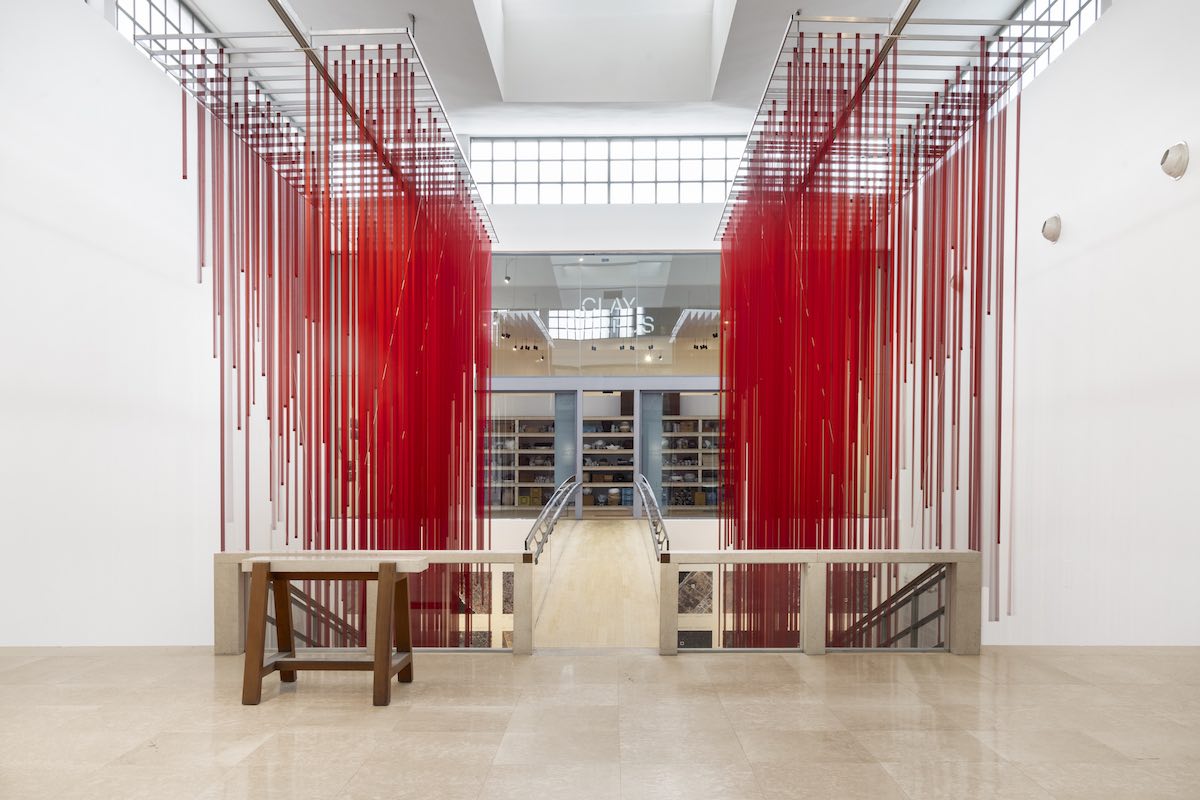
Inequalities. 471 Days installation.
Sometimes, architecture is felt more than seen. Filippo Teoldi transforms the Triennale’s main staircase into a monument of memory, marking the 471 days between Hamas’s attack on October 7, 2023, and the fragile ceasefire in January 2025. Hanging from the ceiling are 471 vertical fabric columns, each one representing a day—its length determined by that day’s reported death toll. The result is immersive, chilling, and deeply human. On the steps below, hand-drawn annotations trace how the violence escalated or paused, with estimated figures for both Palestinian and Israeli casualties. Designed in collaboration with Midori Hasuike, the installation invites silent reflection, a rare moment of stillness in a bustling show.
SHAPES OF INEQUALITIES
Ground Floor
Shapes of Inequalities exhibition.
Ever felt overwhelmed by statistics? Designer and data artist Federica Fragapane brings a sense of calm—and beauty—to the chaos. Her exhibition doesn’t just show numbers; it tells stories through hand-drawn, multilayered illustrations that dig deep into global disparities. Think of it as an emotional map of inequality, covering everything from climate injustice (who emits vs. who suffers) to wealth gaps, migration, gender, healthcare, and even our own internal ecosystems. Each piece is based on rigorous research, but Fragapane’s visuals remind us that data is never neutral—it’s shaped by people, choices, and power structures. You’ll leave seeing charts in a whole new way.
WE THE BACTERIA: NOTES TOWARD BIOTIC ARCHITECTURE
Upper Floor Experimental Hall

We the Bacteria exhibition.
Here’s a wild one: what if architecture wasn’t just for humans? Curated by legendary theorists Beatriz Colomina and Mark Wigley, this mind-bending show rethinks how we relate to the microscopic life forms that live inside and around us. The exhibition begins by reminding us of a simple fact: we are outnumbered by bacteria. From there, it travels through architectural history—from antiseptic white walls to utopian sanitation projects—and ends with nine collaborative installations that pair architects with microbiologists to design new ways of living with microbes. You’ll find experimental materials, living surfaces, and speculative habitats. Equal parts science lab and design fiction, it’s weird, provocative, and strangely hopeful.
THE REPUBLIC OF LONGEVITY. IN HEALTH EQUALITY WE TRUST
Health & Wellbeing Pavilion

The Republic of Longevity. Photo by Delfino Sisto Legnani, DSL Studio.
Who says ageing has to be a medical problem? This joyful, thoughtful installation—curated by Nic Palmarini and Marco Sammicheli—challenges the medicalisation of ageing and the inequalities that restrict access to healthy living. The show offers a new perspective, reimagining the ageing process as a collective project for dignity, access, and joy. Five metaphorical ministries—Purpose, Sleep Equality, Food Democracy, Physical Freedom, and Togetherness—guide visitors through installations that combine research, storytelling, and personal reflection. There are beanbags, touchscreens, soundscapes, and even kitchen setups. The Republic of Longevity argues that small daily choices, if made equitably accessible, can make a big difference.
A JOURNEY INTO BIODIVERSITY. EIGHT FORAYS ON PLANET EARTH
Immersive Corridor – Ground Floor

A Journey Into Biodiversity exhibition.
Philosopher Telmo Pievani takes you on an adventure across eight imaginary cities—each inhabited not just by humans, but by animals, plants, fungi, and even bacteria. These multisensory “stations” aren’t just educational—they’re beautifully designed micro-worlds crafted from biodegradable materials, returning to nature after the exhibition ends. There’s a city for mushrooms, where networks of mycelium are explained through sound and light; a city for octopuses, full of flowing, tactile forms; and a city of humans that feels surprisingly alien when viewed in the full planetary context. The message? We’re not separate from biodiversity—we are biodiversity. It’s a heartfelt call to rethink the word “we” in broader, more inclusive terms.
NOT FOR HER – AI Revealing the Unseen
Lower Level Interactive Gallery

Inequalities. Not for Her exhibition – Photo by Luca Trelancia.
What happens when you let artificial intelligence explore gender inequality? This multimedia experience, curated by Milan’s Politecnico University, digs into that question—and doesn’t hold back. In the first room, a triptych of digital projections presents stark data on discrimination in the workplace, translated into immersive, emotion-charged visuals. Step into the second space, and you’re part of the installation: an interactive system that confronts your own perceptions, challenging the unconscious biases we all carry. It’s not a scolding—it’s an invitation to unlearn and reimagine. Think of it as a mirror, but one powered by code and empathy.
Photos are by Alessandro Saletta and Agnese Bedini, DSL Studio. © Triennale Milano – Unless indicated otherwise.

Inequalities. The Republic of Longevity. Photo by Delfino Sisto Legnani, DSL Studio.