Escape Room by Andrea Angelidakis at Venice Art Biennale 2026 – Photo by Andrea Avezzù.
Art, Architecture. At the Venice Art Biennale, visual artist and architect Andreas Angelidakis takes over the Greek Pavilion at the Giardini with Escape Room — part labyrinth, part philosophical provocation, and one of the Biennale’s more sharply conceived queer spaces.
- RELATED STORIES: Discover more more queer architecture and design on Archipanic.

Photo by Andrea Avezzù.
The pavilion channels Plato’s Cave, an allegory of prisoners mistaking shadows for reality, into something pointedly contemporary: a hall of distortions where digital illusion, post-truth politics, and neo-fascism collapse into one another. “Everything distorts, displaces and repackages — you can discern the truth from deceptive images,” Angelidakis told Archipanic. At Escape Room, truth splinters into replicas, projections, staged realities, and algorithmic noise.

Photo by Andreas Avezzù.
The space itself is dense with intent. Visitors move through soft architectural ruins and accumulations of objects that operate as shards of collective memory — from the Greek Civil War to the moment Peggy Guggenheim took over the pavilion to present Cubist and Surrealist works, then read as gestures of anti-fascist resistance.

Photo by Jacopo Salvi.
At the centre, a surveillance camera films itself in an unblinking loop. Opposite it, a pink outline of the pavilion’s façade stretches across spaces originally conceived as ecclesiastical wings — a quietly subversive move. A black fabric installation at the pavilion’s entrance marks a quiet act of homage — to Greek artist Vaso Katraki, who took a prize at the 1966 Venice Biennale before being imprisoned for her political convictions.

Photo by Jacopo Salvi.
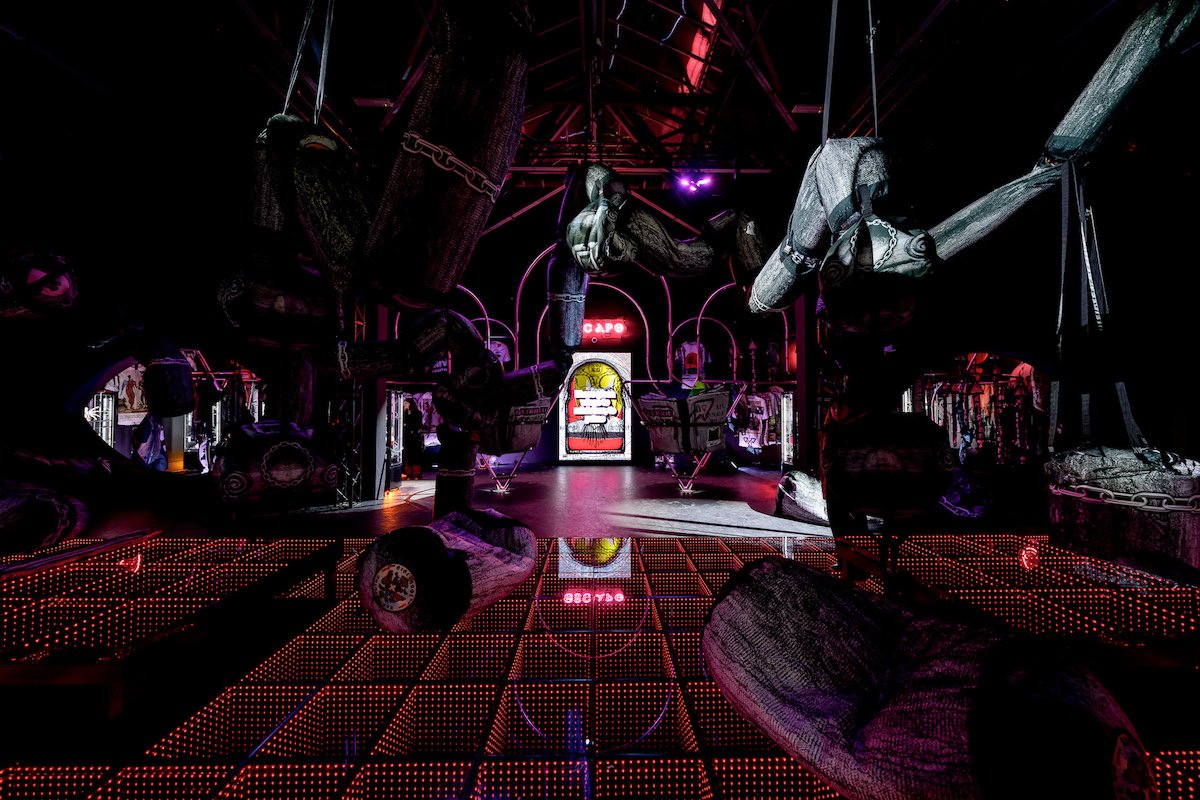
Queerness here is structural, not decorative. For Escape Room, Angelidakis opted for a queer space — one where, in his words, “identity is not connected to its function.” An LED floor, exaggerated aesthetics, and flamboyant display strategies evoke a gay nightclub as much as an exhibition space.

Photo by Vladimiros Nikolouzos.
The queer perspective, he argues, “affords one distance from society at large, and when you are excluded from something, this gives you the opportunity to observe from a distance.” Rather than offering a coherent historical reading, Escape Room embraces ambiguity, distortion, and humor as navigational tools for an era defined by the instability of political and cultural identity.

Photo by Vladimiros Nikolouzos.
The exhibition connects past and present, reflecting on a world where history itself is repackaged as consumable merchandise. The architecture of the Greek Pavilion carries its own political charge. Completed in 1934 — the year of Hitler and Mussolini’s alliance — the building is a loaded backdrop, and Angelidakis leans directly into that discomfort.
Escape Room is curated by Giorgos Bekirakis, with the Metropolitan Organisation of Museums of Visual Arts of Thessaloniki – MOMus serving as national commissioner.

Photo by Andreas Avezzù.
Photos by Andrea Avezzù, Jacopo Salvi, and Vladimiros Nikolouzos.

Photo by Jacopo Salvi.