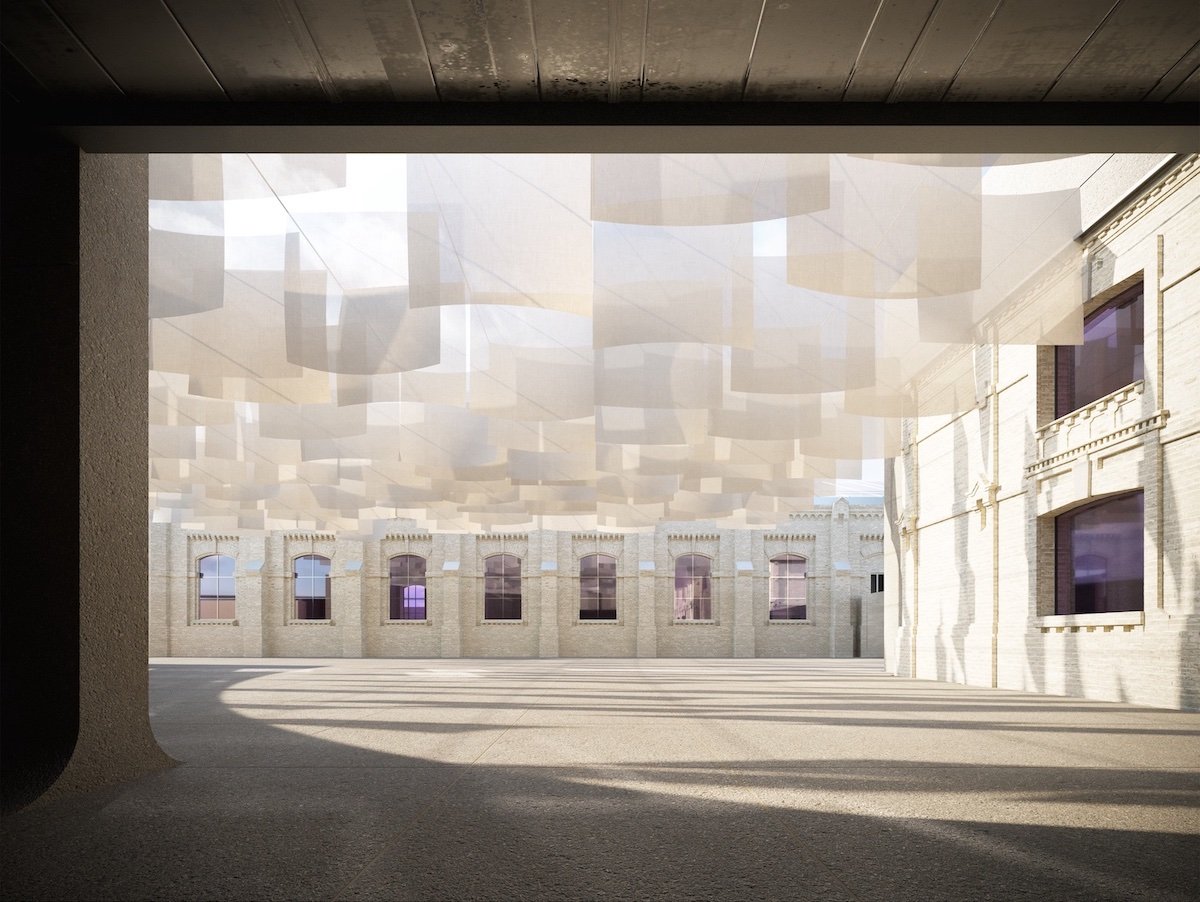
Courtyard of the Centre for Contemporary Arts Tashkent by Studio KO.
Architecture. Opening this March, the Centre for Contemporary Arts Tashkent marks a significant cultural moment — the first institution of its kind in Uzbekistan. Entrusted to Paris-based Studio KO, the project sees a distinguished 1912 industrial building reborn as a dedicated space for creativity, research, and community engagement in the heart of Tashkent.
- RELATED STORIES: Discover more Uzbek architecture and design on Archipanic.

The building carries considerable heritage. Designed by architect Wilhelm Heizelmann, it originally functioned as a diesel station and depot for the city’s first tram line — a rare and quietly commanding Tsarist-era presence within the urban fabric.

Studio KO’s intervention honours that history with care and intelligence, preserving the structure’s industrial character whilst layering in new design elements that draw on traditional Uzbek materials and light-filtering motifs. The result is a considered conversation between past and present, handled with genuine sensitivity.
Founding architects Karl Fournier and Olivier Marty describe their approach as giving the industrial shell a “new poetic life,” working with local materials and motifs to create spaces for evolving artistic encounters.

The 3,200 sqm renovation is organised around a raw concrete courtyard that also serves as an open-air cinema. At street level, the building presents reception spaces and a bookshop to the public; the upper floors house staff offices, with a substantial library occupying the top floor. A sequence of smaller rooms — designed to welcome, orientate, and manage visitor flow — leads to the project’s most compelling space: the Diesel Station, located on level -1.

Diesel Station.
Artists’ residencies are situated in equally resonant surroundings: a historic 19th-century madrassah and mosque, and a former kindergarten, both set within older neighbouring quarters of the city.

The Centre for Contemporary Arts Tashkent is led by the Uzbekistan Art and Culture Development Foundation (ACDF) and its chairperson, Gayane Umerova. The inaugural exhibition, Hikmah, curated by Dr Sara Raza, anchors the 2026 programme with site-specific commissions developed in direct dialogue with the building and its architecture.

A wider programme of public events and cross-disciplinary initiatives will extend the reach of the Centre for Contemporary Arts Tashkent beyond its gallery walls, affirming its ambition to serve as a meaningful space for exchange and dialogue across disciplines and audiences.

Visuals © Studio KO, courtesy of the Uzbekistan Art and Culture Development Foundation, unless stated.
- RELATED STORIES: Discover more eclectic museums on Archipanic.


Centre for Contemporary Arts Tashkent by Studio KO – Photo by © BCDF Studio, courtesy of ACDF.