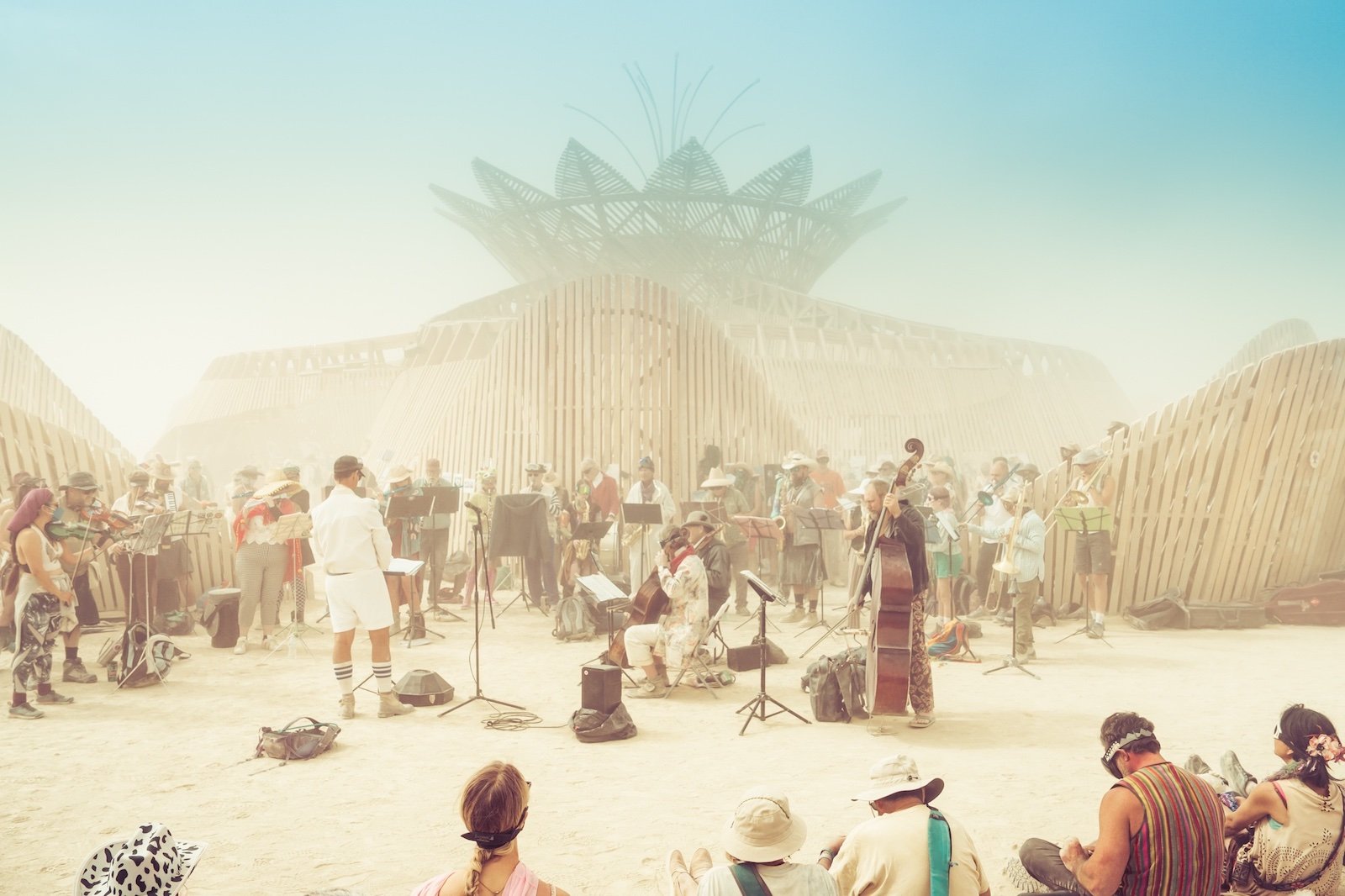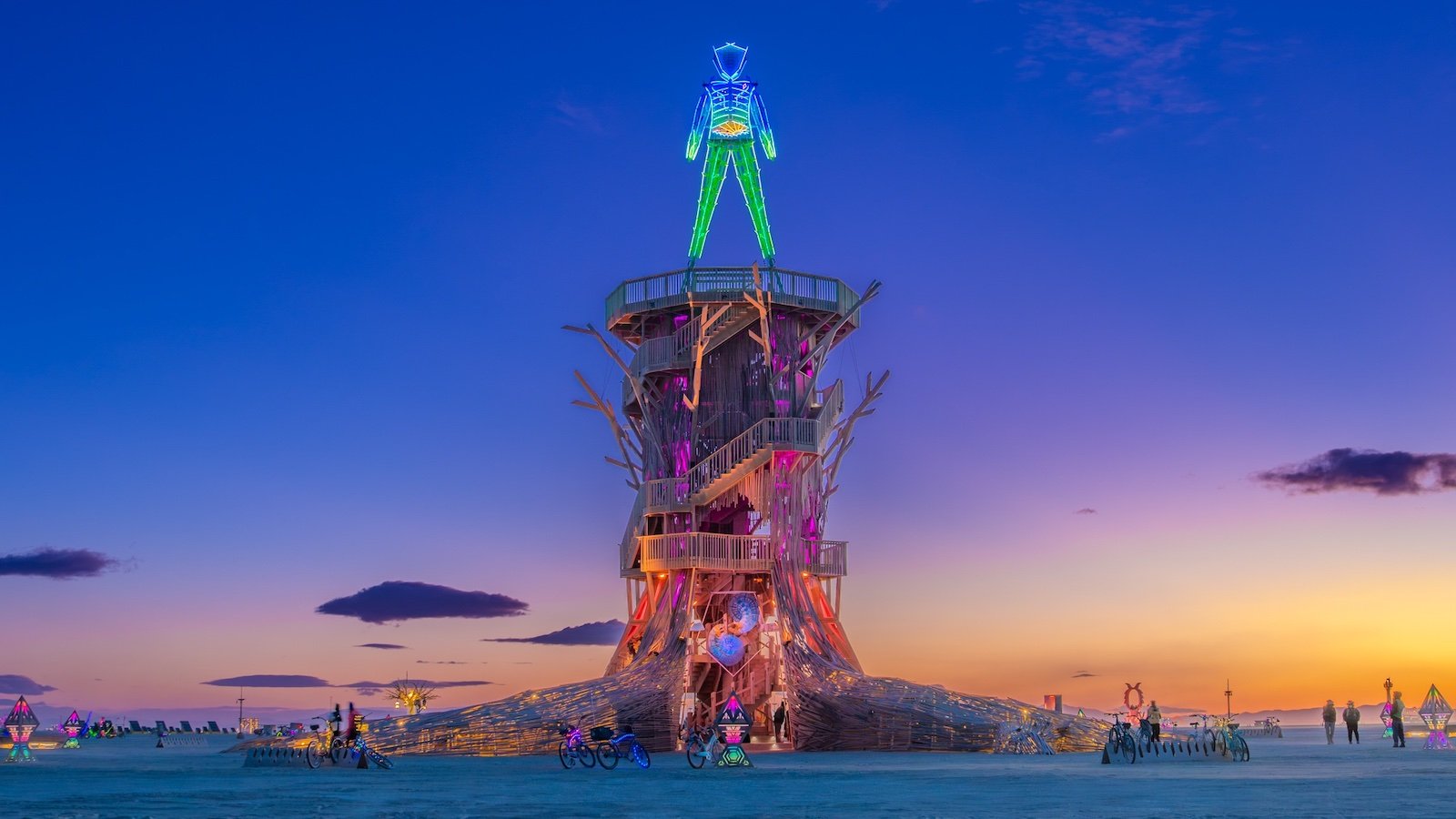
The Man Pavilion by Alexander ‘Zander’ Rose at Burning Man 2026 – All photo are by Mark Fromson, unless stated otherwise.
Art, Architecture. Every civilisation has reached for its own Axis Mundi — a fixed point and a mystical denominator connecting us with powers greater than ourselves. That was the main theme of Burning Man 2026, the festival that each year lifts a temporary metropolis out of Nevada’s Black Rock Desert, only to burn it back down to ashes by week’s end. We selected some of the most mesmerising architectural adventures that rose from the sands, captured through Mark Fromson‘s lens.
- RELATED STORIES: Read more about Burning Man on Archipanic.
An Architectural Nocturnal Bloom
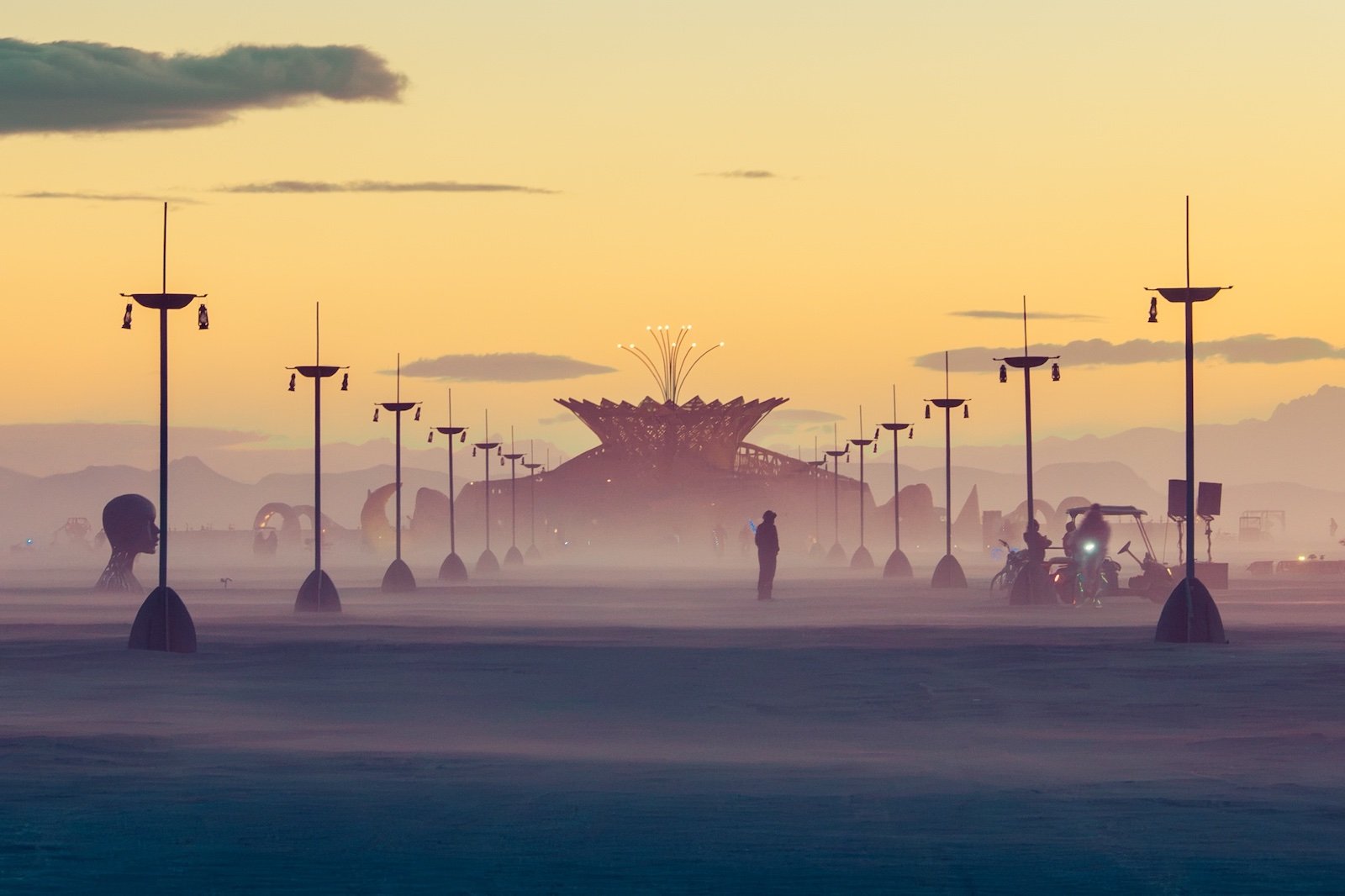
The main shrine of Burning Man 2026 was the Temple of the Moon, built by James Gwertzman and his Moonlight Collective. Its design drew on the Queen of the Night, a desert cactus that produces one of nature’s most poetic gestures: a single bloom, unfurling after dark, gone before morning. Concentric timber petals shaped a thirty-foot tower, its wooden blossom mechanically opening each evening and closing by dawn.
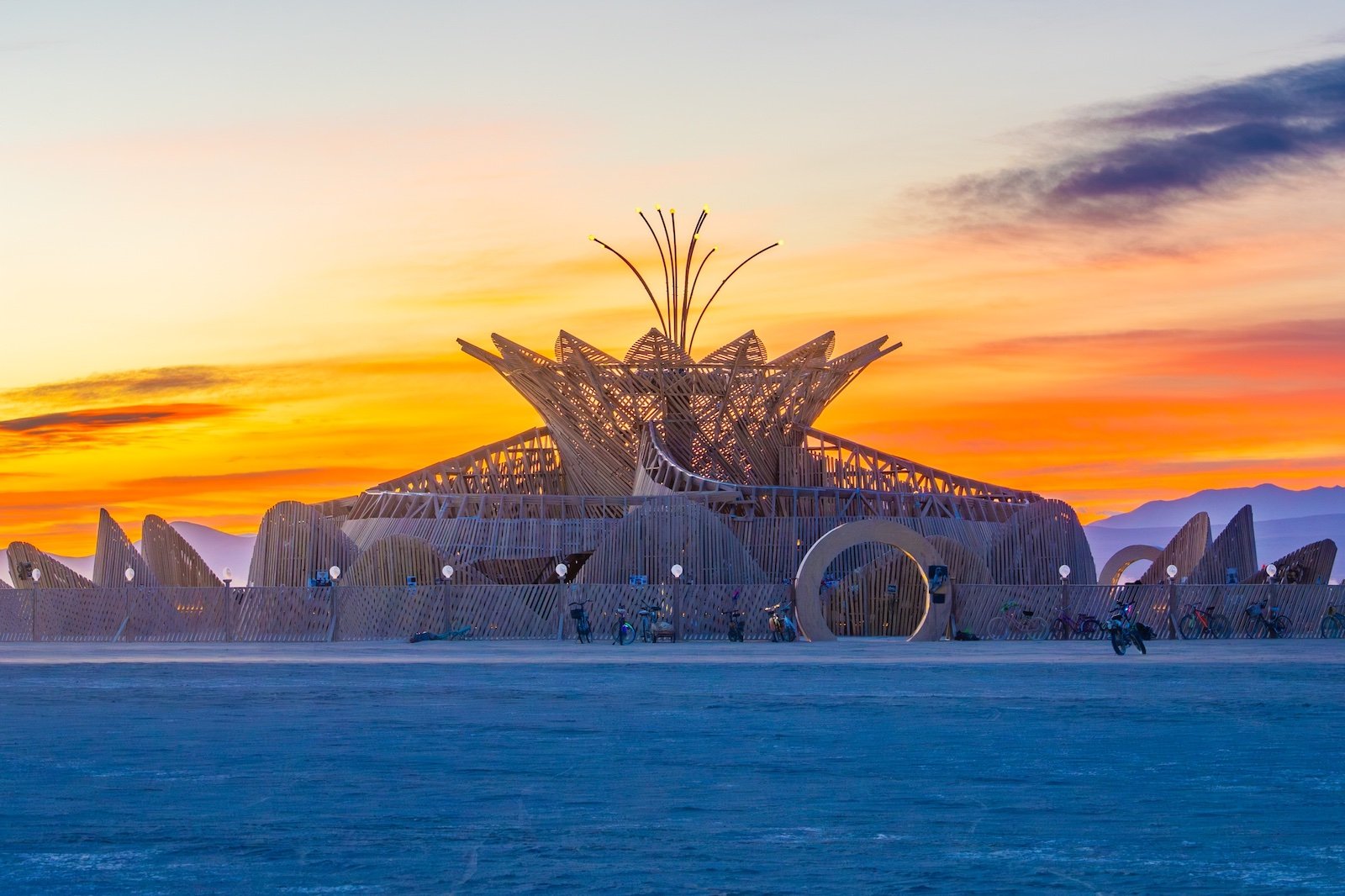
As the collective explained: “In a world that feels increasingly fast and relentless, the temple offers a quieter counterpoint. A place to slow down, to be with what is here, and to hold space for one another.” Read more…
The Man Pavilion as a living ecosystem
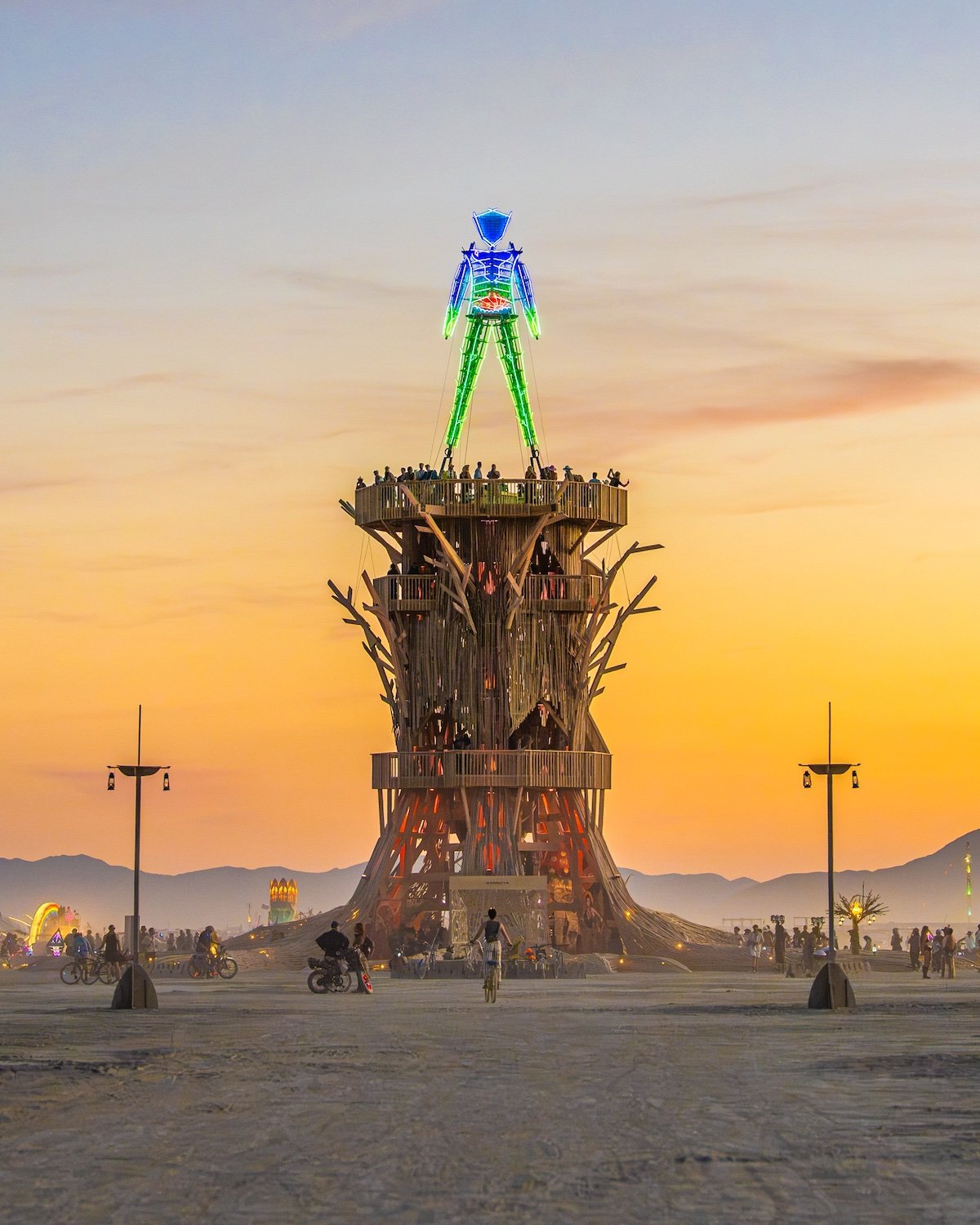
Rather than the customary plinth, Californian designer Alexander Zander Rose gave the Man a three-tiered pavilion conceived as a living organism, part tree and part temple. The structure works as an Axis Mundi in its own right, connecting the natural world, humanity and the celestial realm. Its reference point was Jōmon Sugi, a Japanese cedar on Yakushima Island believed to be between 2,170 and 7,200 years old. Root-like paths drew visitors towards the centre, where a double-helix staircase spiralled upward in a quiet nod to DNA — an ancient framing device, reworked for Burning Man 2026.
A broken Eiffel Tower with a message of hope
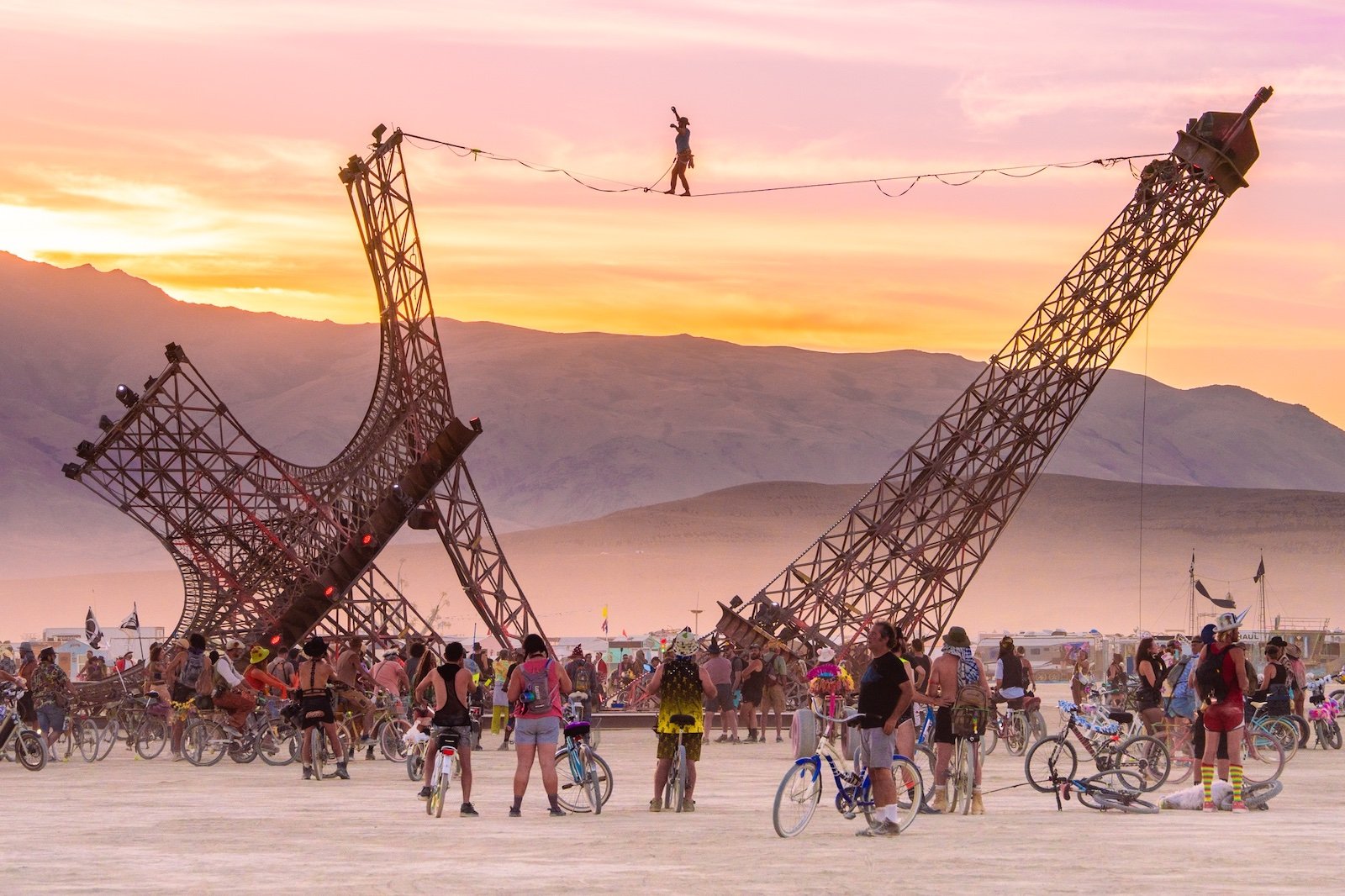
From France, Philippe Maindron’s contribution was Eiffela Broken Dream, a 1:10 Eiffel Tower, crashed onto the playa and split into two enormous sections. The broken architecture “explores the tension between collapse and hope.” The lower section, partly planted in the ground, symbolised the sinking of a lost civilisation; the upper half, pointing toward the sky, offers hope for a brighter future. Between the two peaks, a taut cable held tightrope walkers aloft. Something monumental might have fallen — but the dream hasn’t.
A Titanic desert shipwreck
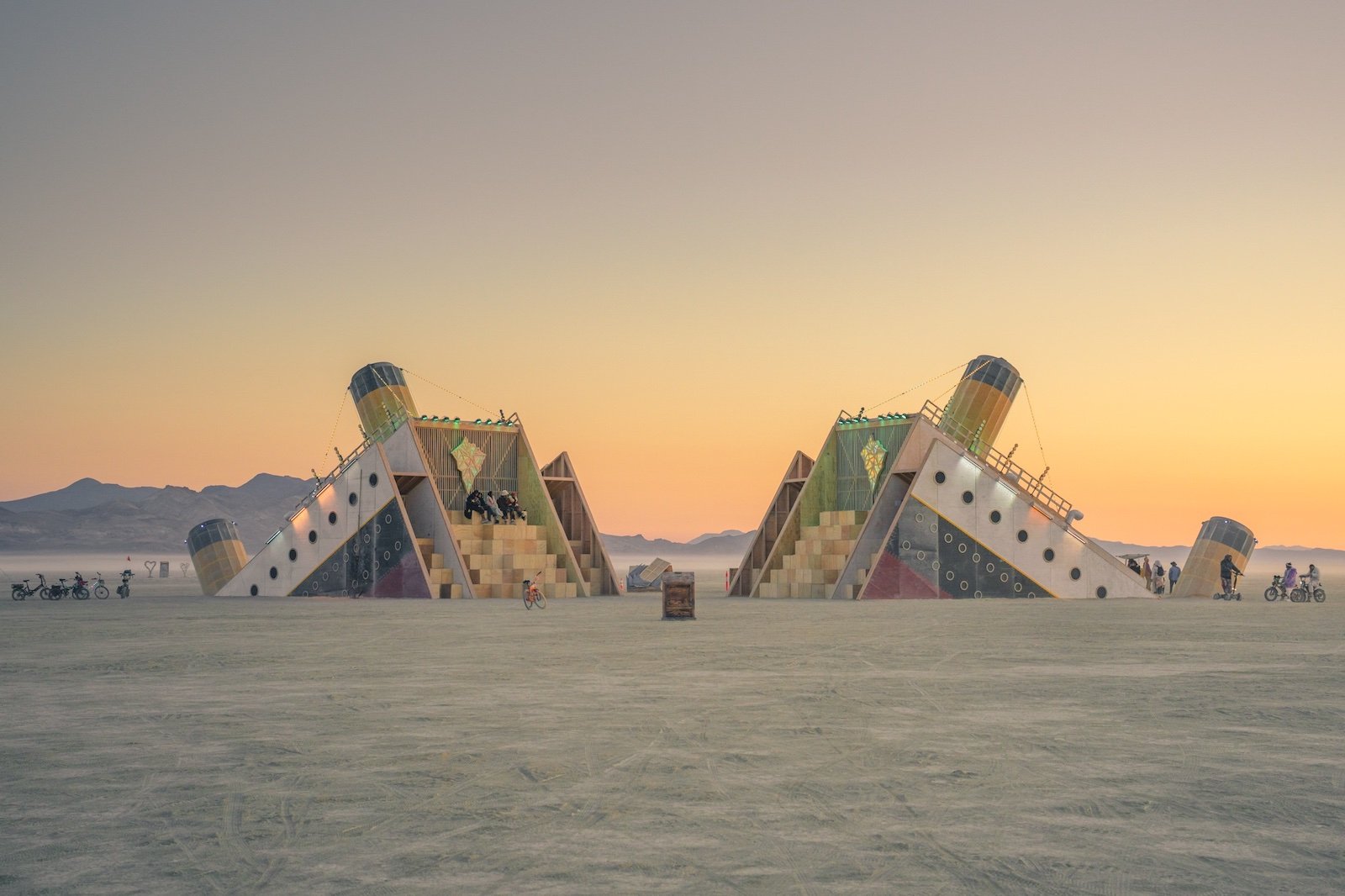
San Francisco’s Titanic’s End collective built TITANIC, a sixty-metre climbable recreation of the infamous ocean liner, cracked in two and appearing to sink beneath the desert floor. By day it served as an amphitheatre for gatherings and sunset-watching; by night, lighting and flame-throwing smokestacks turned it into a fire sculpture. “TITANIC represents the hubris of man and his faith in technology. As we continue to extract resources from the world at ever greater scale, will we find a sustainable equilibrium with the planet? Or will it end in tragedy?”
A secular yet spiritual, glowing cathedral
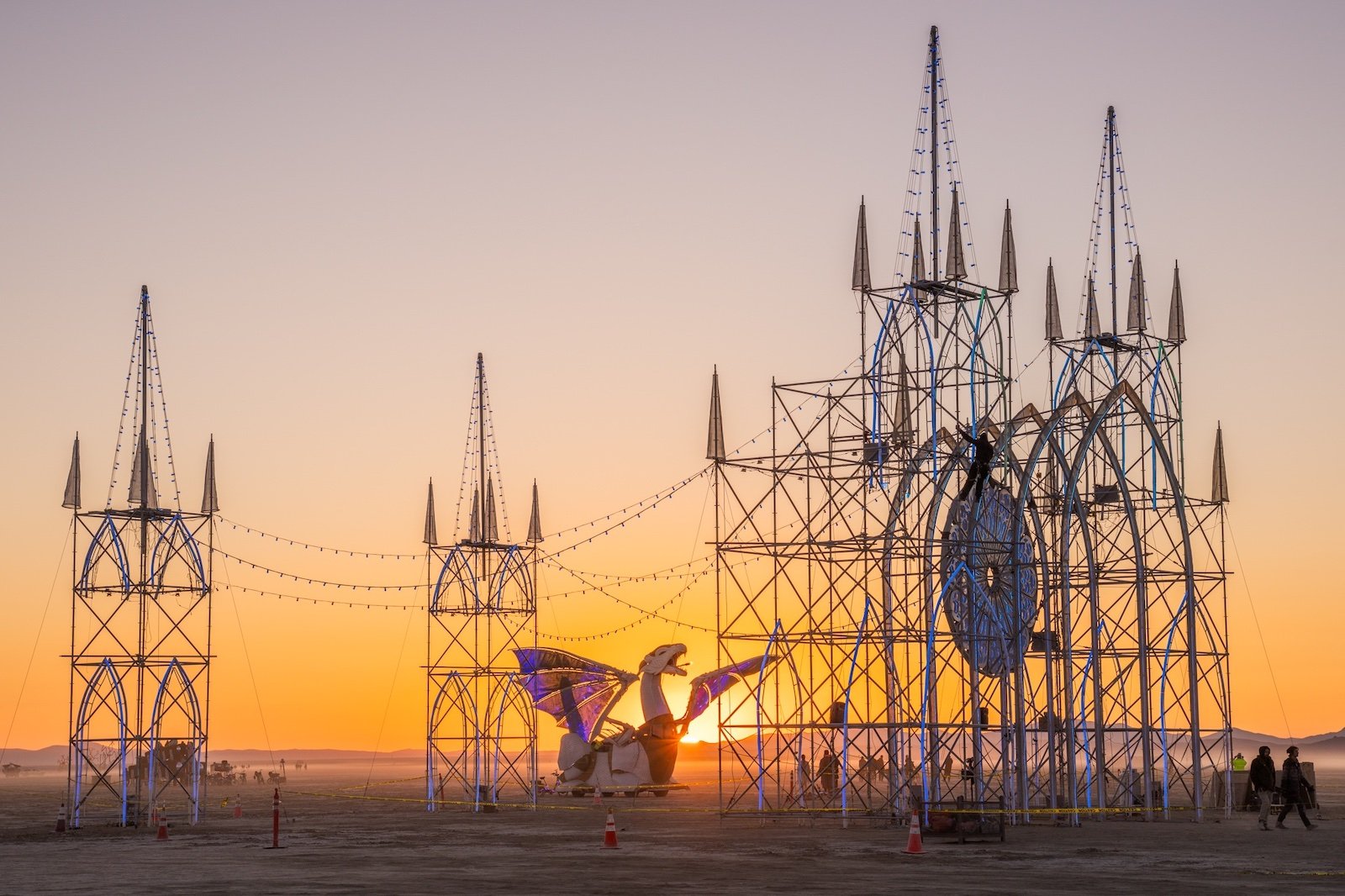
New Yorkers Alex Noerpel and Hunter Keene built “a sacred space without doctrine” — a skeletal lattice of towers, arches and luminous panels, at once gothic ruin and futuristic folly. By day, coloured panels cast stained-glass light across the sand; by night, the structure glowed as a beacon visible across the playa. Without recourse to any particular faith, the ‘temporary cathedral’ was a fitting reminder that Burning Man 2026 could summon the sacred without ever naming it.
A tongue-in-cheek tower for burners
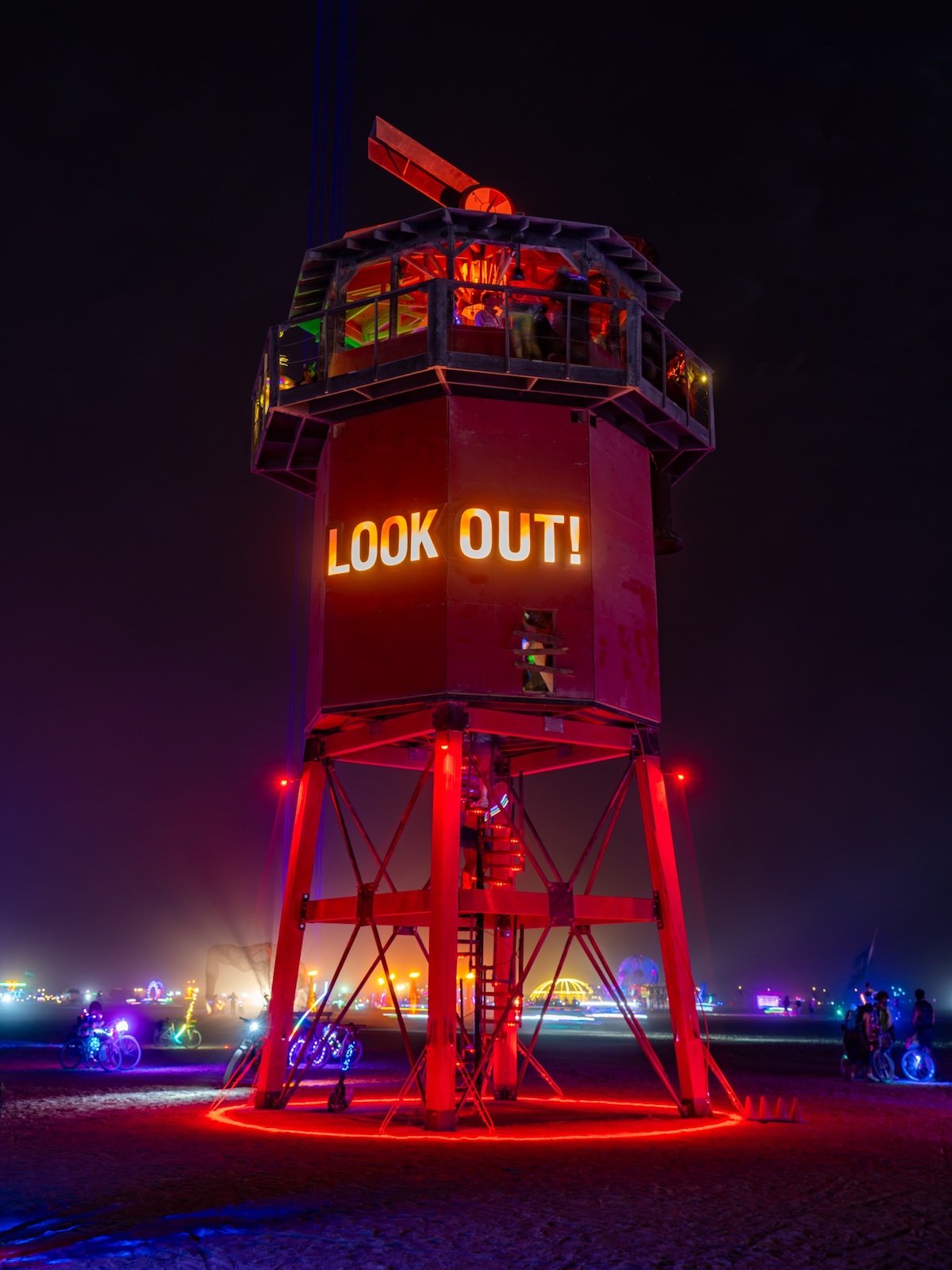
LOOKOUT! by Franzi Ponzi and the Homo Erectors at Burning Man 2026 – Photo by Mark Fromson, follow @autobiographica.
Franzi Ponzi and the Homo Erectors brought welcome wit with LOOKOUT!, a fire lookout tower disguised as a giant fire extinguisher. Part observation deck, part architectural folly, it blurred “the line between the delight of watching a fire burn and the urgent desire to extinguish the flames engulfing our world,” the makers noted. That contradiction is particularly pointed at Burning Man, where fire is itself part of the spectacle and ritual.
Fairytale architecture along the beanstalk
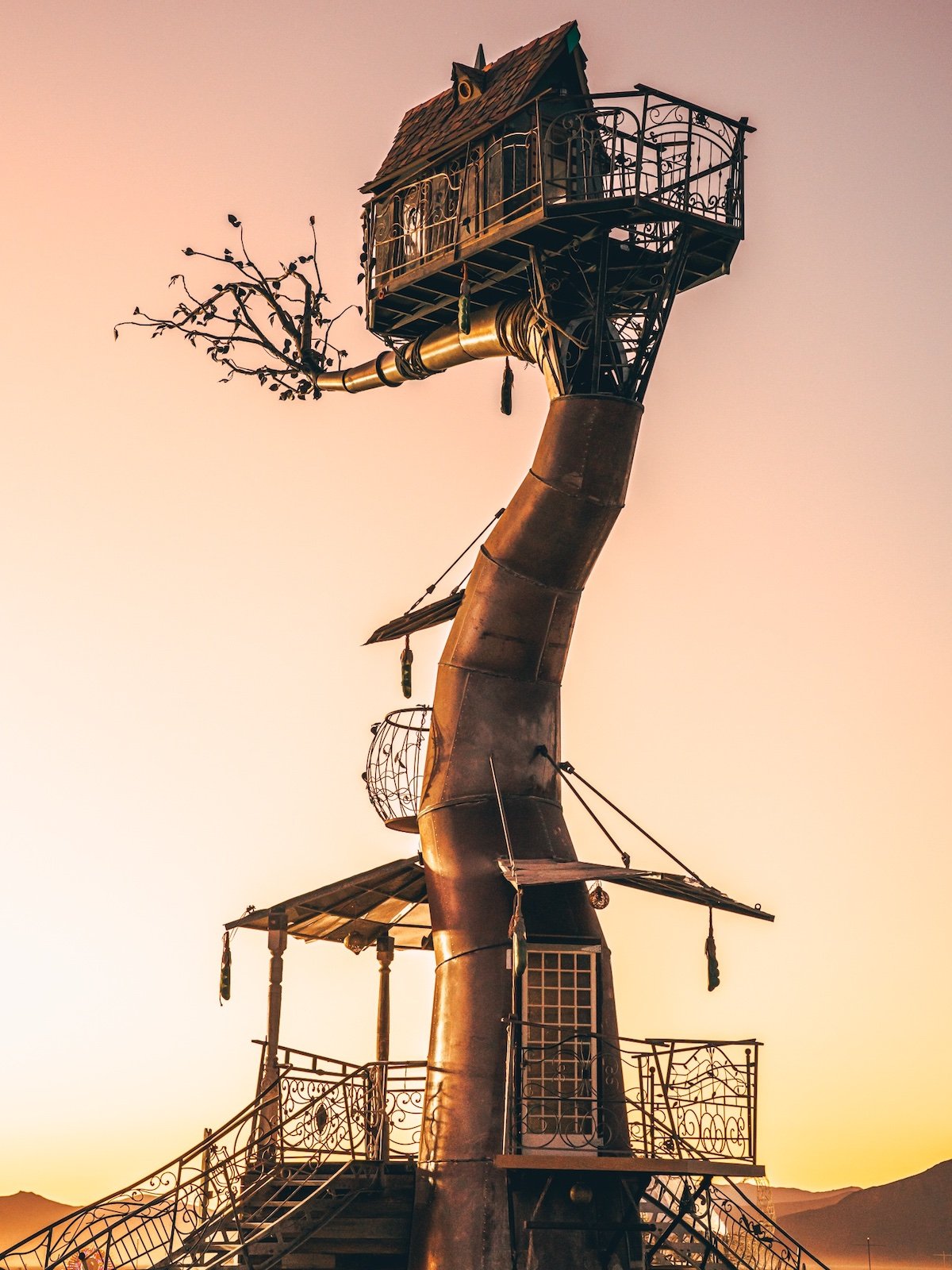
Sean Orlando and the Five Ton Crane Collective combined a house at ground level, a huge twisting, climbable beanstalk and a small Victorian cottage suspended high above the playa. Titled Above and Below, the work, he says, “embodies the artistic impulse to shape our homes and communities into creative gathering spaces that evoke mystery, nature, adventure, and spirituality.” A gently fantastical entry, proof that Burning Man 2026 still had room for pure storytelling alongside its weightier conceptual work.
An architectural take on the mystic power of the number 7
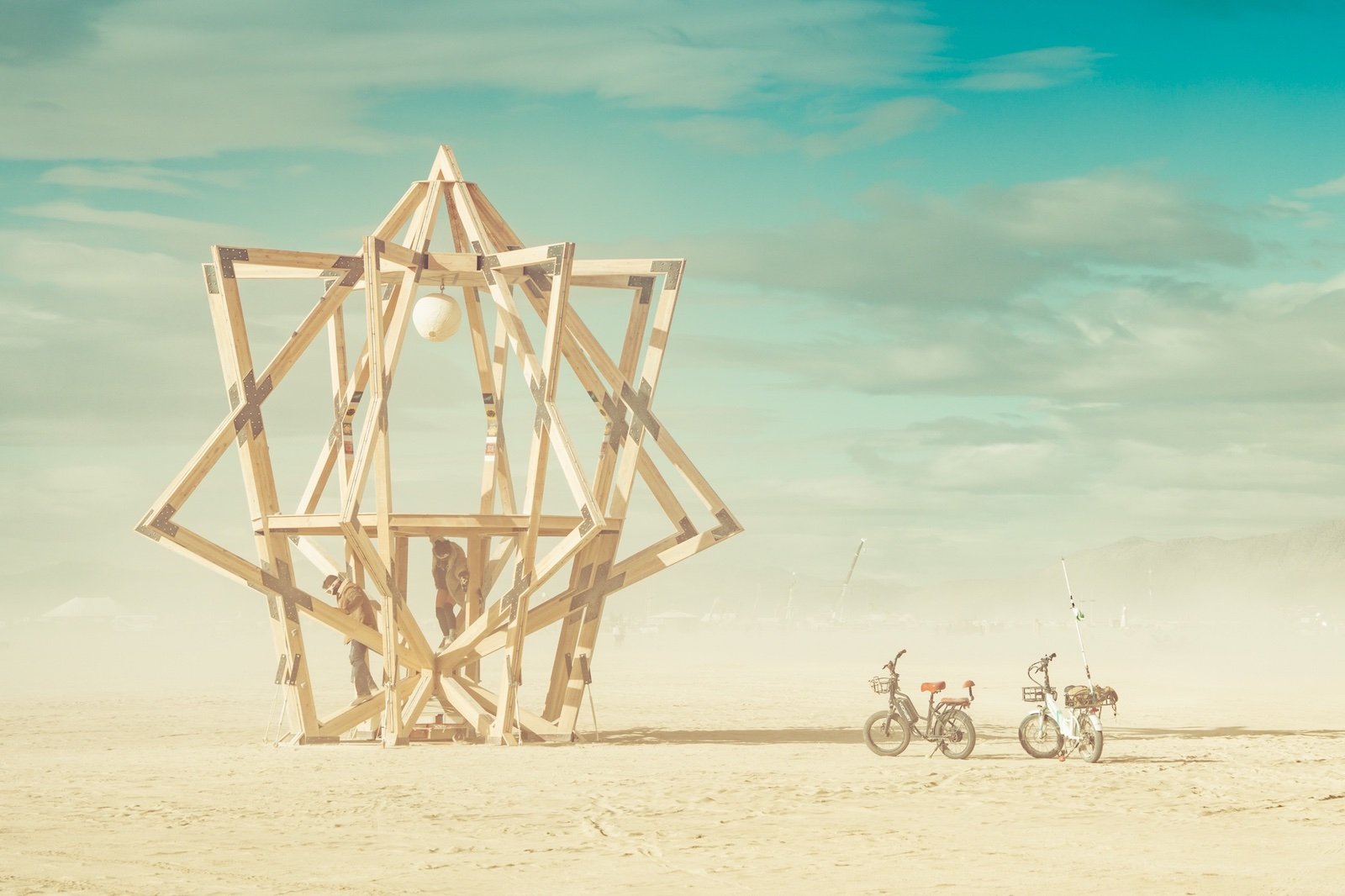
Dave Ray and Michael Jacob of Lux Productions leaned fully into symbolism with Septima Stella Lux, an 8.5-metre timber structure formed from four intersecting seven-pointed stars, climbable and explorable from within. LEDs recessed along the beams lit it after dark. “The number seven runs deep through human culture — Jewish and Muslim mysticism, the seven days of creation, seven chakras, seven deadly sins — and here it read less as ornament than as a recurring human attempt to order the universe: spiritually, mathematically, musically, metaphysically at once.”
An in-wonderland Moroccan tea party
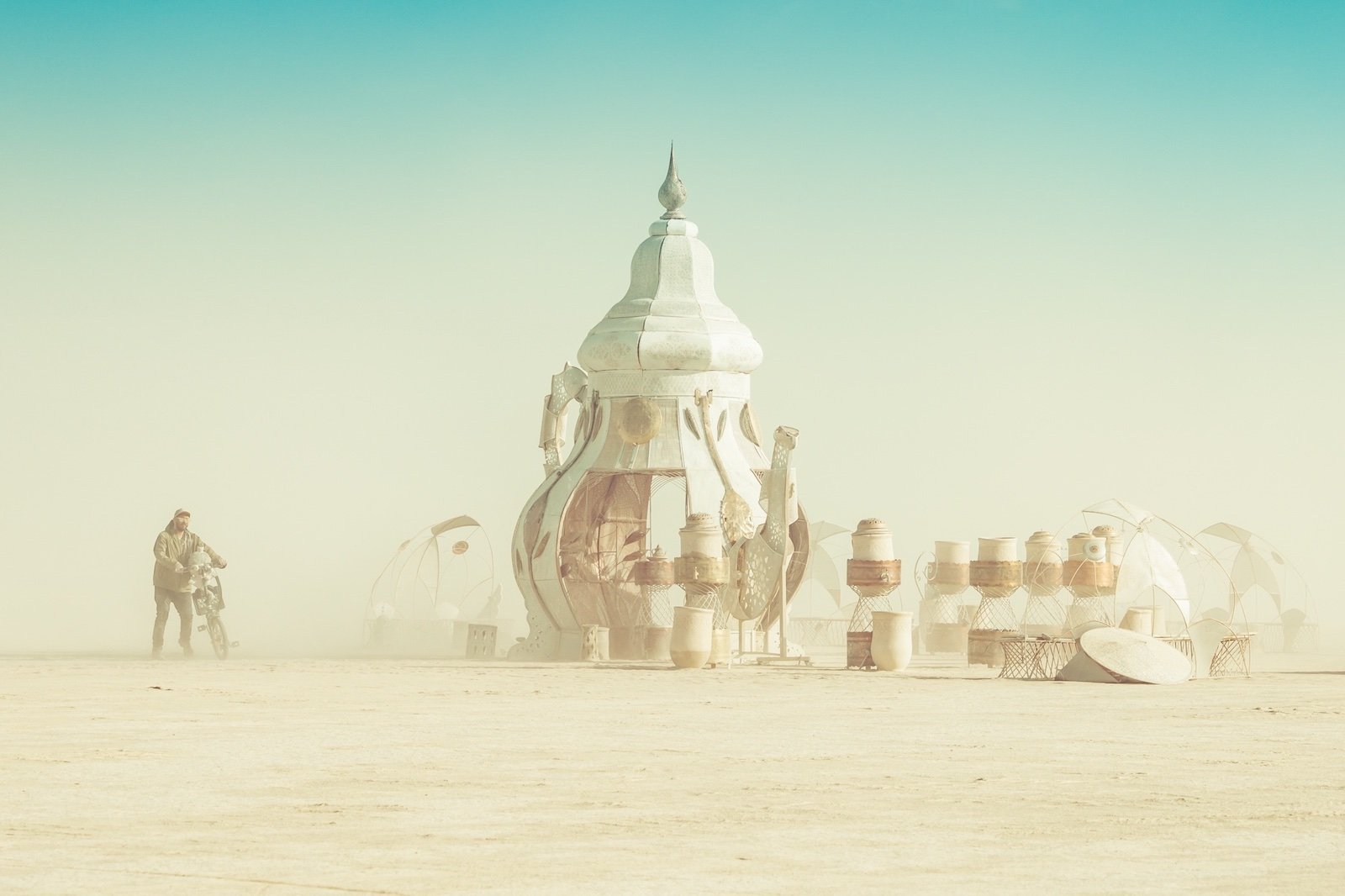
Hind Baghdadi, from Kenitra and Marrakesh, translated an everyday ritual into monumental form with Moroccan ParTea, an oversized teapot-and-glass installation built using traditional techniques and transported to the desert against considerable odds. The gesture, she says, is a deeply personal one: “A Moroccan citizen welcomes everyone with open arms and open hearts no matter their age, gender, religion, race, colour – none of that matters.” A warm, human-scaled counterpoint to the desert’s larger architectural gestures.
A threshold both primordial and sci-fi
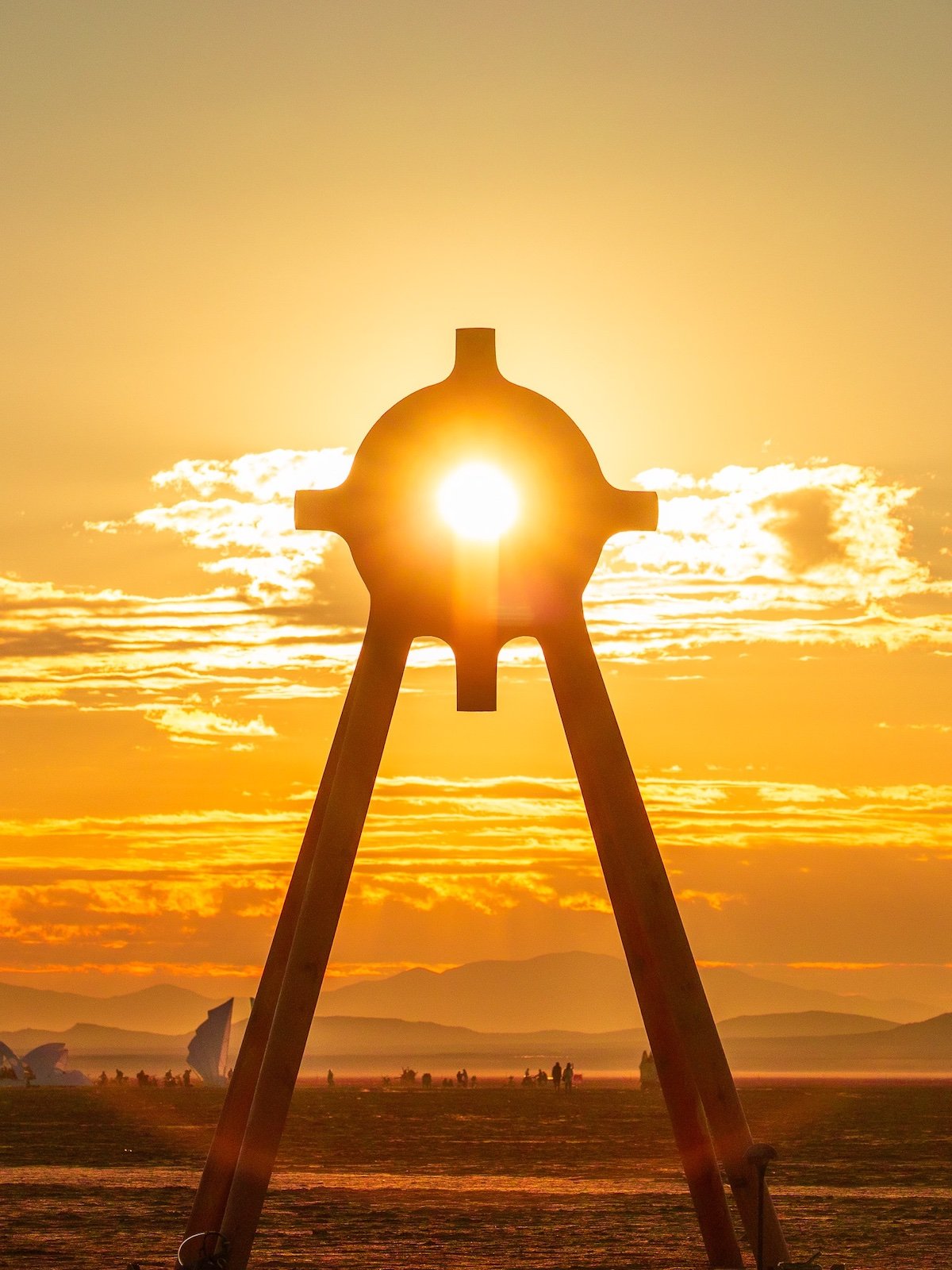
Aleph Geddis built Ancient Future Portal, a six-metre portal that felt both primitive and futuristic, familiar and alien, as if from a culture that has encountered something beyond its understanding. Four angled legs supported a central body with a circular opening, veiled in translucent film, suggesting a threshold between the visible world and something less defined. “A space beneath the structure created a threshold between past, present and an imagined future.”
A tower translating voices into light
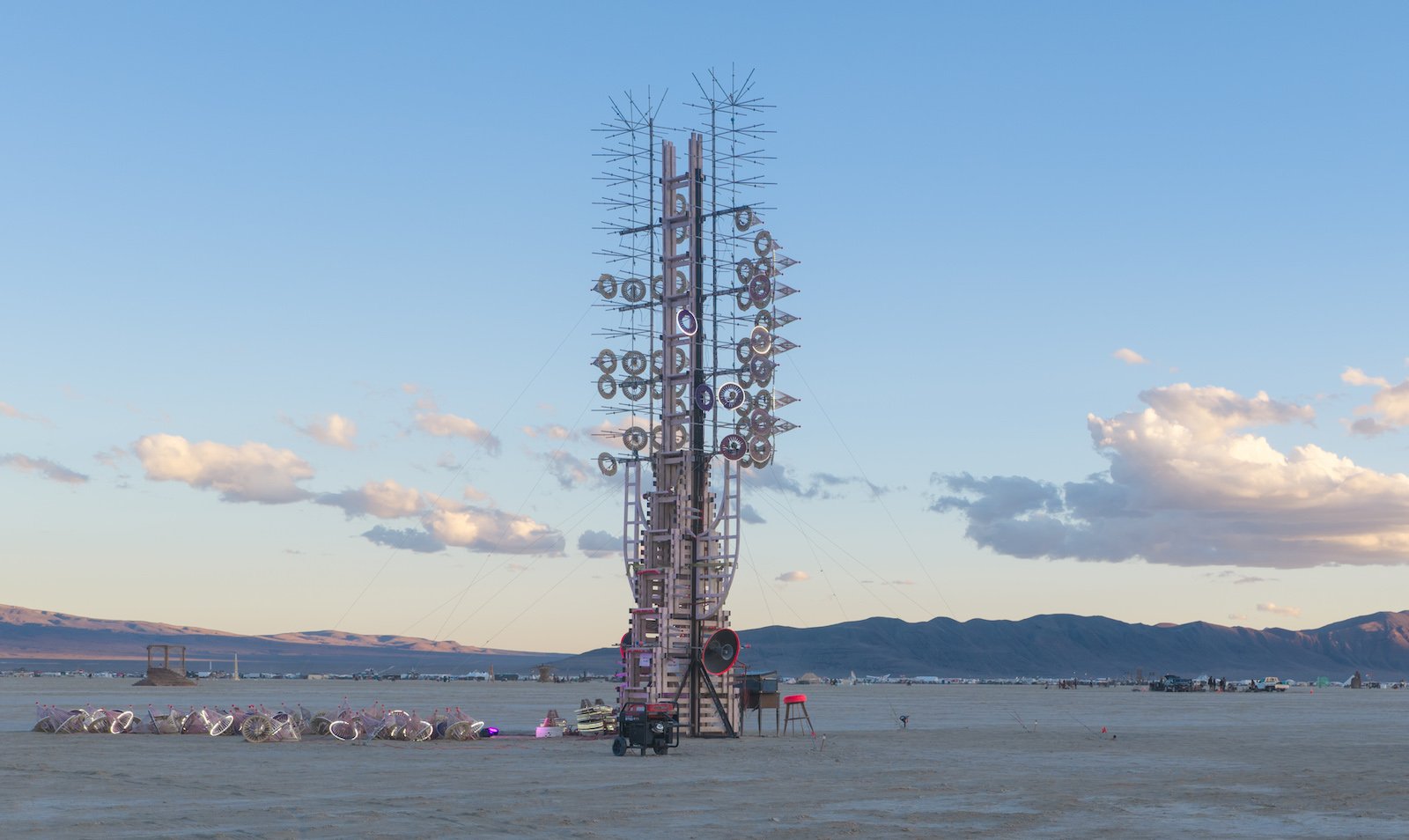
Photo by Rand Larson.
Sergei Konchekov‘s Axis Mundi installation treated the desert as a responsive instrument. A twelve-metre timber spire, surrounded by cones and three hundred programmable rings of light, captured the crowd’s sound and voices, translating them into luminous shifting patterns. In his words: “Matter and algorithm intertwine; structure becomes frequency; architecture becomes event.” Where the ancient version of this idea fixed a static link between earth and heaven, the tower became alive and collective — a fitting close for this year’s Burning Man 2026 roundup.
All photos are by Mark Fromson; follow @autobiographica – Unless stated.
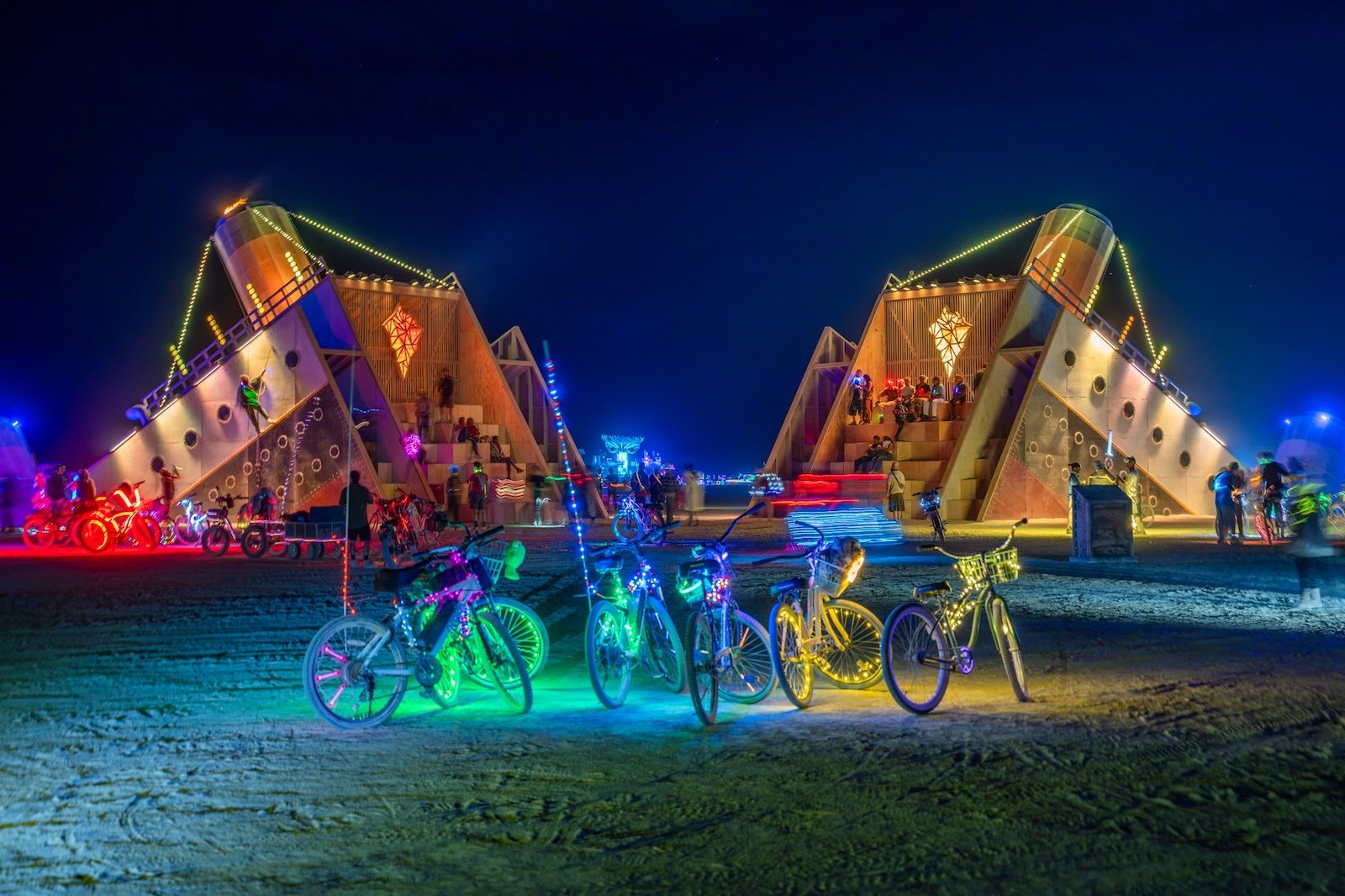
Titanic by Titanic’s End collective.
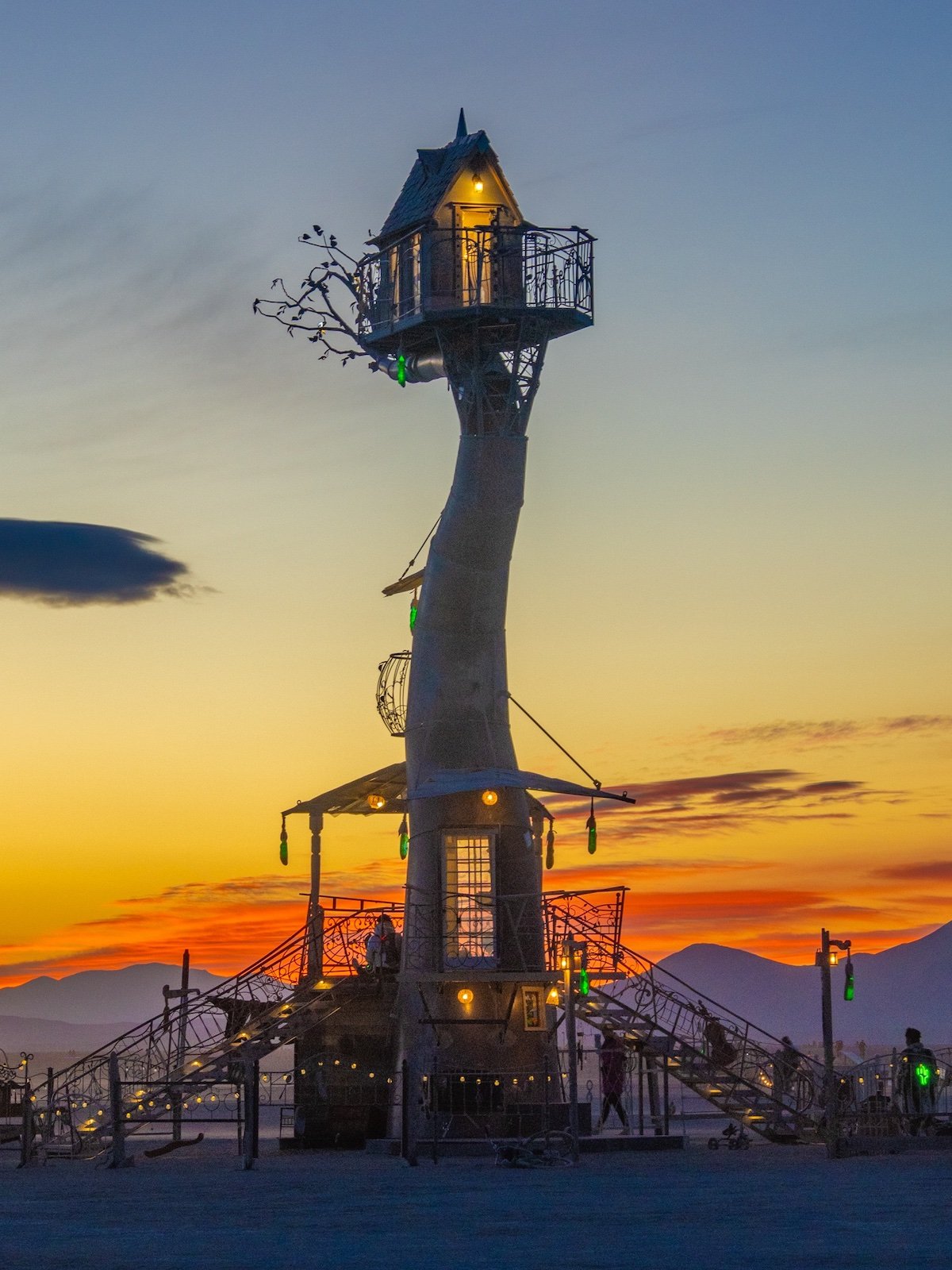
Above and Below by Sean Orlando and the Five Ton Crane Collective.