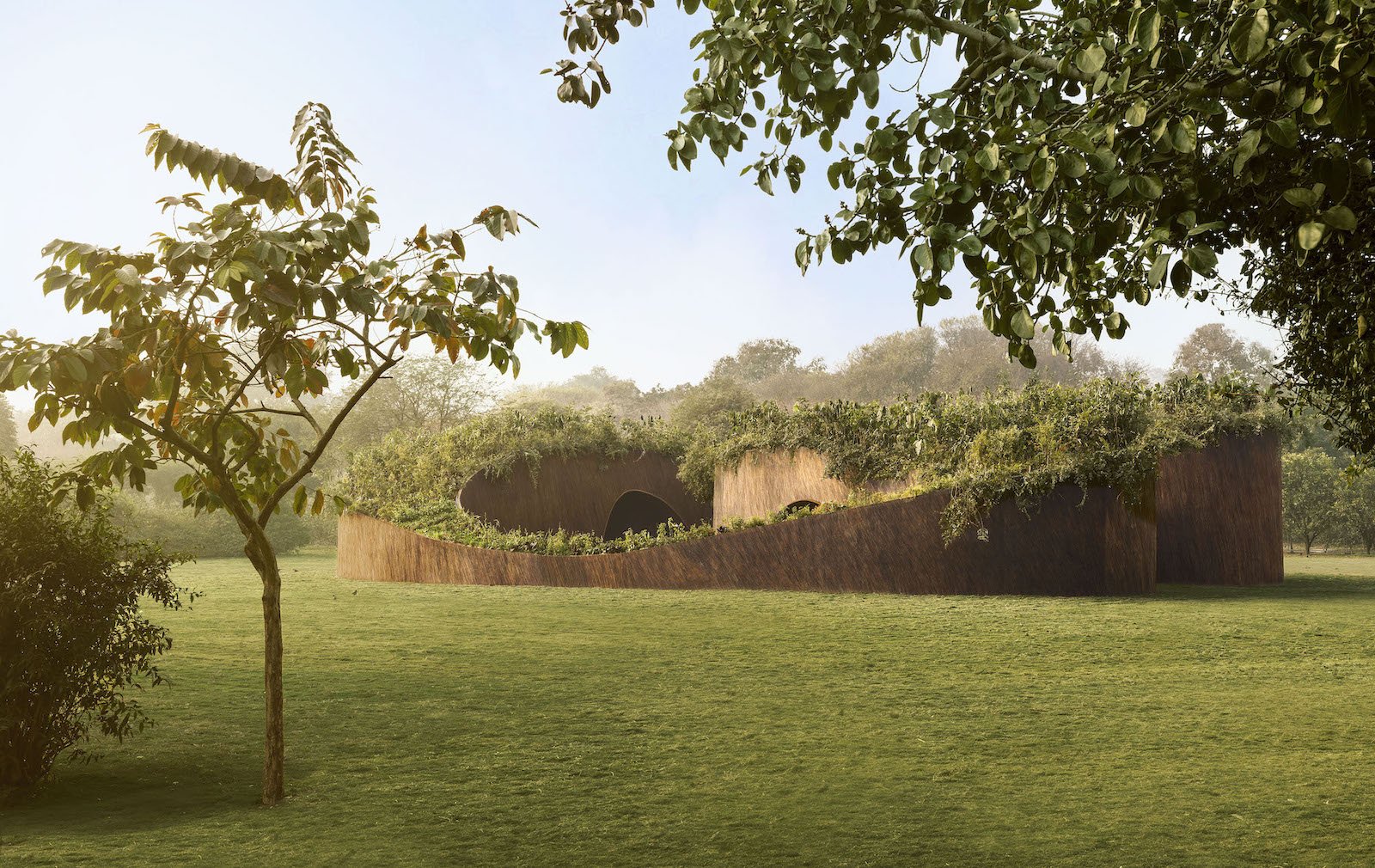
Aranyani Pavilion by Tara Lala and T__M.space – All photos are by Lokesh Dang.
Architecture. At this year’s India Art Fair in New Delhi, Tara Lal, founder of Aranyani, and T__M.space unveiled the biophilic Aranyani Pavilion, a sinuous structure crowned with a living roof within Sunder Nursery’s verdant gardens. It marks the inaugural annual commission by Aranyani, a conservation and creative arts initiative reconnecting people with nature. Until February 20, the architecture hosts performances, talks and workshops on ecology.
- RELATED STORIES: Discover more Indian architecture and design on Archipanic.

Named Sacred Space, the pavilion honours a forest goddess from ancient India’s sacred texts. Visitors follow a continuous path through shifting light, shadow, texture and sound. The spiralling architecture choreographs an inward journey echoing a living forest’s rhythm. The discovery culminates at a central shrine, anchored by a large stone monolith that recalls the ritual cores of sacred groves.

The Aranyani Pavilion is built from upcycled Lantana camara, an invasive shrub introduced through Portuguese and British colonial trade in the 18th century, that now threatens nearly half of India’s forest cover. The team has transformed Lantana into a structural framework.

Above sits a living canopy of more than 40 native plant species—a thriving micro-habitat of edible, medicinal and culturally significant varieties. Layering invasive Lantana beneath indigenous species above, the pavilion embeds restoration into its very structure. It acknowledges India’s colonial ecological past whilst gesturing towards renewal.

“We wanted to open a dialogue on decolonising approaches to nature and biodiversity,” explains Tara Lal, founder of Aranyani. “So many of our ecological crises are rooted in colonial histories and systems that separated us from land, from Indigenous knowledge, and from one another.”

The Aranyani Pavilion invites visitors to repair that rupture, experiencing ecology “not as abstraction but as something we walk through, feel, and belong to. “Through bringing invasive and native species into conversation, “we hope to create space for local and international dialogue on how we might restore not only ecosystems, but the relationships that sustain them.”

Following its Sunder Nursery presentation, the structure will become a permanent, living classroom for students, researchers and emerging naturalists at the Rajkumari Ratnavati Girls’ School in Jaisalmer. The edible and medicinal plants will be transferred to ongoing community-led environmental projects in Delhi, extending the Aranyani Pavilion ethos of repair.

All photos are by Lokesh Dang.
- RELATED STORIES: Discover more plant-related architecture and design on Archipanic.